Every time markets hit new highs, investors begin to whisper the same question: Is this the top?
In 2025, with U.S. stock indices near all-time highs, global debt at record levels, and geopolitical risks escalating, the fear of a sudden market crash is very real. For cautious investors and retirees, the instinct is to pull money out of volatile assets and move it somewhere “safe.” And for many, that means gold.
But should you really move all your money to gold before the next crisis? Or would that leave you overexposed, underperforming — and vulnerable in other ways?
This article unpacks the real risks and rewards of going all-in on gold in 2025. We’ll cover market history, portfolio math, asset behavior during crashes, and smarter strategies to hedge without overreacting.
Why Gold Feels Safe — Especially Right Before Crashes
Gold has always had a psychological edge. It’s tangible. It’s not tied to any government. It doesn’t go bankrupt. And when markets panic, gold tends to go up while everything else goes down — or at least hold its ground.
In 2008, while stocks collapsed by 50%, gold held relatively steady and surged afterward. In 2020, during the COVID crash, gold dipped briefly but then hit new all-time highs.
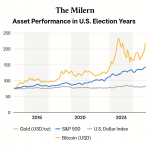
Now in 2025, gold is once again near record levels — trading above $3,400 — and investors are nervous.
Reasons people are moving into gold now include:
- Fear of recession or stagflation
- Distrust in central banks and fiat currency
- Concerns about U.S. debt, political instability, or war escalation
- Belief that stocks and real estate are overpriced
But while gold has been a historic safe haven, that doesn’t mean it’s the only one — or that putting all your money there is a wise move.
What Happens If You Move Everything to Gold?
Let’s imagine you go all-in:
- No stocks
- No bonds
- No cash
- No real estate
- Just gold bars, coins, ETFs, or allocated storage
Here’s what you gain:
- Protection against inflation or fiat collapse
- A hedge against war, currency devaluation, and market fear
- Less exposure to interest rates or company defaults
But here’s what you lose:
- Income — gold pays no dividends or interest
- Liquidity — selling physical gold quickly can be difficult
- Upside — if markets rise instead of fall, you miss gains
- Diversification — all your eggs are now in one shiny basket
Most importantly: you’ve bet on one specific outcome — a sharp crisis where gold outperforms. If that scenario doesn’t happen right away, you could underperform for years.
How Gold Actually Performs During Crashes and Recessions
Gold’s reputation as a crisis hedge is mostly earned — but the reality is more nuanced. It doesn’t always surge during a crash, and its behavior depends on why markets are falling.
Here’s how gold has historically performed during major downturns:
2008 Global Financial Crisis
- Stock Market: S&P 500 fell over 50%
- Gold: Dropped 20% briefly, but recovered and soared to all-time highs by 2011
- Key Point: Gold was liquidated early for cash, but became a go-to asset after the initial panic
2020 COVID Crash
- Stock Market: S&P 500 fell 34% in a month
- Gold: Dipped slightly, then surged above $2,000 by mid-2020
- Key Point: Gold proved resilient and outperformed most other assets
1970s Stagflation
- Stock Market: Flat or declining in real terms
- Gold: Rose from ~$35/oz to over $800 by 1980
- Key Point: Gold thrives during inflationary fear and monetary debasement
2022–2023 Inflation Shock
- Stock Market: Volatile with tech weakness
- Gold: Traded sideways, briefly rising
- Key Point: Gold didn’t collapse, but also didn’t shine — other hedges like T-bills performed better in the short term
Summary Table: Gold in Past Crises
| Crisis Period | Stocks | Gold Behavior | Notes |
| 2008 Financial Crisis | –50% | –20% → +200% | Gold surged post-crash, not during it |
| 2020 COVID Crash | –34% | Mild dip → surge | Gold rebounded faster than equities |
| 1970s Stagflation | Flat/down | Massive rally | Peak inflation = best period for gold |
| 2022–2023 Rate Spike | Choppy | Sideways | Gold held steady, didn’t lead |
Conclusion:
Gold is a strong hedge, but it doesn’t always protect during the crash — sometimes it shines after it, especially when monetary policy loosens again.
What the Wealthiest Investors Actually Do
Most billionaires and family offices don’t put 100% of their wealth into gold — but almost all of them do hold some. The difference is in how they allocate it.
Here’s a typical defensive asset allocation used by sophisticated investors:
| Asset Class | Allocation Range | Purpose |
| Gold (physical + ETFs) | 5–15% | Inflation hedge, crisis insurance |
| Cash / T-bills | 10–20% | Liquidity during downturns |
| Stocks (global) | 40–50% | Growth engine over time |
| Bonds | 10–20% | Income and risk balancing |
| Real Estate | 10–20% | Income and inflation resistance |
Even highly cautious investors like Ray Dalio or central banks like the PBOC (China) and the ECB (Europe) only allocate part of their reserves to gold. The logic is simple:
“You don’t bet the farm on fear. You insure it.”
Smarter Ways to Hedge Against a Crash Using Gold (Without Going All-In)
If you’re worried about a market crash, it makes sense to increase your gold exposure — but that doesn’t mean abandoning everything else. There are more effective, balanced ways to hedge using gold without compromising long-term performance or liquidity.
Here are some proven strategies:
1. Allocate 5–15% to Gold as a Core Hedge
This is the most common approach used by institutional investors, financial advisors, and central banks.
- Physical gold gives you sovereignty and storage independence
- Gold ETFs (like GLD or IAU) offer instant liquidity and tax efficiency
- Gold mining stocks add leverage but also more volatility — useful for small tactical positions
This strategy gives you protection in the event of inflation, currency devaluation, or a confidence shock — while still allowing the rest of your portfolio to benefit from growth assets.
2. Use Gold to Anchor a Defensive Portfolio
If you’re nearing retirement or want to reduce drawdown risk, a defensive portfolio with a gold component makes sense.
Example mix:
- 40% dividend stocks or ETFs
- 30% short-term Treasuries or TIPS
- 15% gold (physical + ETFs)
- 10% high-quality real estate trusts (REITs)
- 5% cash or liquidity reserve
This kind of portfolio won’t shoot the lights out during bull markets — but it’s designed to survive storms and preserve capital.
3. Pair Gold With Cash or Short-Term Bonds
Both gold and cash are defensive assets, but they behave differently:
- Cash protects against market volatility and gives flexibility
- Gold protects against inflation, currency risk, and systemic shocks
Holding both means you’re covered for multiple scenarios. If rates drop or inflation spikes, gold may rise. If equities fall and liquidity dries up, cash gives you optionality.
4. Avoid Overconcentration in Gold Miners or Leveraged ETFs
Some investors chase gold’s upside by buying:
- Gold mining stocks (e.g., Barrick Gold, Newmont)
- Leveraged ETFs (e.g., UGL, NUGT)
These instruments offer amplified returns — but also amplified losses. They can underperform actual gold during market stress due to cost structures, management inefficiencies, or leverage decay.
If you’re using these, keep the allocation small and time-sensitive.
The Hidden Risks of Going All-In on Gold
While gold offers safety and historical value, moving all your money into it introduces a new kind of danger — one that’s harder to see: opportunity loss and psychological rigidity.
Here are a few less obvious risks that come with going all-in:
You Lose Access to Compound Growth
Gold preserves value — but it doesn’t create value.
If you move everything out of productive assets like stocks or real estate, you lose the compounding effect that powers long-term wealth. A dollar in the S&P 500 from 1990 to 2020 grew ~10× (despite crashes). That same dollar in gold grew ~4×. The difference adds up over decades — especially when you factor in inflation.
You’re Betting on Just One Outcome
Going 100% gold means you believe the next few years will bring:
- A major crash
- Central bank policy failure
- Fiat currency weakness
- Broad economic fear
If you’re right, you’ll sleep well. But if markets keep rising — or if inflation cools and tech keeps surging — your portfolio could underperform for years, creating frustration or regret.
Market history shows that even during prolonged crises, the world doesn’t end — it adapts. In that recovery phase, gold usually lags behind risk assets.
Emotional Anchoring Becomes Harder to Break
Once someone moves all their capital to gold, it’s psychologically harder to re-enter the market. This leads to stagnation, missed rallies, and timing mistakes. The emotional relief of “I’m safe” often turns into anxiety: “When should I get back in?”
This is especially dangerous for retirees or pre-retirees who are living off their assets. You may protect your nest egg in the short term — but it won’t grow with your needs over time.
Inflation Can Still Hurt
Ironically, gold isn’t immune to inflation-based erosion — at least in the short run. If inflation rises but gold trades flat (as it did in parts of 2022–2023), your purchasing power still declines. Without interest or dividends, you’re stuck relying on price appreciation alone.
The better approach? Use gold as a counterbalance, not a centerpiece.
Final Thoughts: Should You Move All Your Money to Gold Before the Next Crash?
If you’re feeling nervous about the markets in 2025, you’re not alone. With global tensions rising, debt spiraling, and asset prices near extremes, it’s natural to want safety — and gold has always symbolized that.
But the answer to the core question — should you move all your money to gold? — is almost certainly no.
Gold is a powerful hedge, a historical store of value, and a smart component of a resilient portfolio. But it’s not an income generator. It’s not a diversified growth engine. And it doesn’t protect against every kind of risk — especially the risk of missing out on future innovation or recovery.
Instead of going all-in, consider:
- Raising your gold allocation to 10–15% during periods of fear
- Pairing it with cash or T-bills for short-term liquidity
- Maintaining exposure to productive assets like stocks and real estate — even if you reduce your position size
- Rebalancing as conditions change — not reacting emotionally
Gold should be a shock absorber, not a lifeboat you never step out of.
History rewards those who stay diversified, stay calm, and prepare without panicking. In times of uncertainty, the strongest portfolios are not those that flee risk entirely — but those that understand it, manage it, and adapt with clarity.
So no, don’t move all your money to gold.
But do move your strategy toward resilience.