
Retirement planning in 2025 is more challenging than ever. With inflation, rising healthcare costs, and market volatility, many are wondering:
Is $750,000 enough to retire on today?
The short answer: Yes — but only with the right plan.
This article explores exactly how to retire on $750,000, who can realistically do it, what kind of lifestyle to expect, and where to stretch your dollars the furthest.
📊 Who Is the $750,000 Retirement For?
While $750,000 doesn’t quite make you wealthy by modern standards, it’s a solid upper-middle nest egg. You’re in a stronger position than the median retiree in the U.S. (who has less than $300,000 saved), but you still need to make calculated choices.
This level of savings could work well for:
- Frugal retirees in low-cost areas (U.S. or abroad)
- Early retirees with side income or part-time work
- Couples with no mortgage and simple lifestyles
- Investors using Social Security to supplement
The challenge is not just making it last — but making it comfortable.
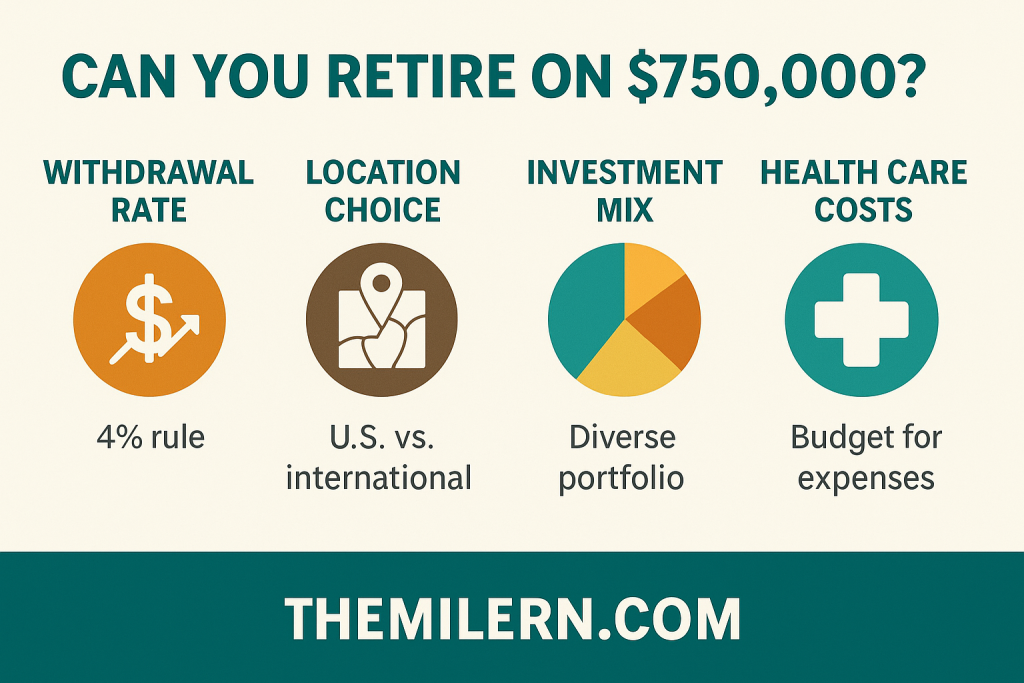
💡 The 4% Rule and How It Applies in 2025
Traditionally, the 4% rule meant you could withdraw 4% of your nest egg each year and expect it to last 30 years. That means:
- 4% of $750,000 = $30,000 per year
- Add Social Security (~$20,000–$36,000 for many retirees)
- Total income: $50,000–$66,000 per year
That’s workable for many retirees — especially if you live in a lower-cost region, avoid debt, and keep healthcare costs under control.
🧮 More conservative planners now prefer a 3.5% or even 3% rule in 2025, due to market uncertainty and higher life expectancy. That would reduce income to ~$22,500/year, not including Social Security.
🏡 Where You Live Changes Everything
Let’s look at how far $750k can go depending on location:
| Location | Estimated Annual Expenses | Years $750k Lasts |
| Rural U.S. Midwest | $35,000 | 21+ years |
| Southern U.S. States | $45,000 | ~16–18 years |
| Portugal | $32,000 | 23+ years |
| Mexico (Lake Chapala) | $28,000 | 25–30 years |
| Thailand | $25,000 | 30+ years |
| Urban California | $65,000 | ~11–13 years |
If you’re willing to retire abroad, your purchasing power nearly doubles. Countries like Portugal, Mexico, Ecuador, and Malaysia offer excellent healthcare, expat communities, and lower daily costs.
🛡️ Inflation, Market Risk, and How to Hedge in 2025–2027
One of the biggest threats to retirees today is persistent inflation. Even at 3–4% per year, it erodes purchasing power over time. For someone living on $50,000 per year, that could mean needing $70,000+ in just a decade to maintain the same lifestyle.
Here’s how to protect your $750,000 from being eaten away:
- Diversify into Inflation Hedges
- Treasury Inflation-Protected Securities (TIPS) adjust with inflation and provide steady, government-backed income.
- Gold and precious metals tend to perform well during global instability or currency weakening.
- Commodities ETFs can offer indirect exposure to materials that rise in inflationary cycles.
- Use Equities for Long-Term Growth
Even in retirement, some stock market exposure is essential. A balanced mix with 40–60% stocks (global + dividend-focused) can outpace inflation and grow your capital base. - Consider a Small Crypto Allocation
For tech-savvy retirees with risk tolerance, a 1–3% position in Bitcoin or Ethereum may offer asymmetric upside.
Crypto is not a core retirement asset, but it may serve as a hedge against monetary debasement or future financial system shifts.
💸 Smart Withdrawal Strategies
Making your $750,000 last isn’t just about what you invest in — it’s also about how you withdraw. Here are smarter ways to stretch your money:
- Use the Bucket Strategy:
Divide your assets into:- Short-term bucket (1–3 years): cash, CDs, short bonds
- Mid-term bucket (3–7 years): dividend stocks, bonds
- Long-term growth (7+ years): equities, REITs, inflation hedges
- Delay Social Security if Possible:
Waiting until age 67 or even 70 can significantly increase monthly payments — a guaranteed source of income adjusted for inflation. - Tap Taxable Accounts First:
Preserve tax-deferred growth in IRAs or 401(k)s longer to reduce required minimum distributions (RMDs) later. - Rebalance Annually:
Maintain your target allocation by trimming winners and reinvesting in lagging areas. This helps control risk and smooth returns.
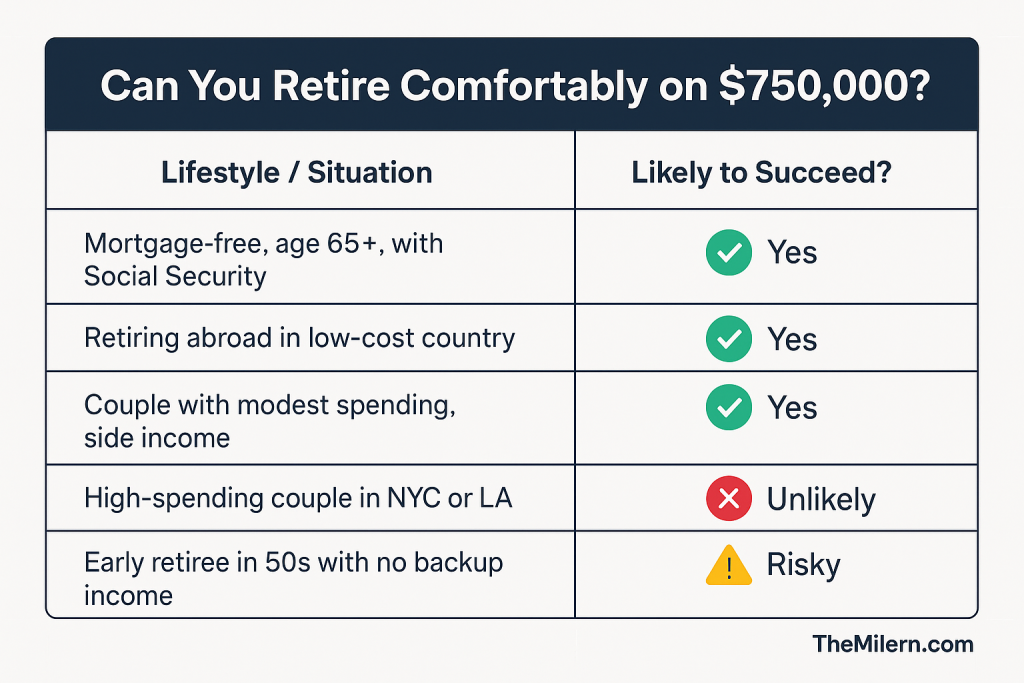
✅ Who Can Retire Comfortably on $750,000?
| Lifestyle / Situation | Likely to Succeed? |
| Mortgage-free, age 65+, with Social Security | ✅ Yes |
| Retiring abroad in low-cost country | ✅ Yes |
| Couple with modest spending, side income | ✅ Yes |
| High-spending couple in NYC or LA | ❌ Unlikely |
| Early retiree in 50s with no backup income | ⚠️ Risky |
If you’re realistic about spending and flexible in where you live, $750,000 can absolutely work for retirement. It requires planning, budgeting, and a willingness to adjust if market conditions or inflation change.
Planning for Longevity and Inflation
When asking whether you can retire comfortably in 2025–2027 with $750,000, it’s not just about how much you have—it’s also about how long it needs to last. Life expectancy is rising, and many retirees could live 25 to 30 years or more after leaving the workforce. That means your nest egg must be resilient against long-term inflation, market downturns, and rising healthcare costs.
At an average inflation rate of 2.5–3%, the purchasing power of your $750,000 could be cut nearly in half over a 25-year retirement. To offset that, your investments must generate real (after-inflation) returns while preserving capital. This makes your asset allocation strategy critical.
Withdrawal Strategies: How Much Can You Safely Spend?
One of the most important decisions you’ll face is how much to withdraw each year without outliving your savings. The traditional “4% rule” suggests you can withdraw 4% of your portfolio in the first year of retirement and adjust for inflation thereafter. With $750,000, that amounts to about $30,000 per year—not including other income sources like Social Security or rental income.
But in today’s low-yield environment, many advisors suggest lowering that to 3.5% or even 3%, especially for early retirees or conservative investors. That would mean:
- $26,250/year at 3.5%
- $22,500/year at 3%
You may be able to stretch that further by:
- Delaying Social Security (to increase monthly benefits)
- Part-time work in early retirement
- Using a dynamic withdrawal strategy based on market conditions
How to Strengthen Your Retirement Readiness with $750,000
If $750,000 is your starting point, you’re in a strong position—especially if you optimize how that money is used. Here are a few ways to stretch your retirement dollars and strengthen your financial resilience:
1. Maximize Social Security Benefits
Delaying Social Security until age 70 can increase your monthly check by as much as 24–32% compared to claiming at 62. This is a powerful form of guaranteed income that grows with inflation and lasts your entire life.
2. Consider Geographic Arbitrage
Living in a lower-cost state or country—sometimes called “geoarbitrage”—can dramatically extend your retirement dollars. For example, someone living on $30,000/year in the U.S. might live comfortably in places like Portugal, Costa Rica, or certain parts of Eastern Europe with significantly lower living expenses and good healthcare.
3. Protect Against Healthcare Shocks
One of the most overlooked risks is out-of-pocket medical expenses. Consider:
- Long-term care insurance (if affordable)
- Health Savings Accounts (HSAs) before retirement
- Medicare Advantage or Medigap to reduce ongoing costs
Also, if you’re retiring before age 65, you’ll need to factor in bridge healthcare coverage until Medicare kicks in.
4. Minimize Taxes
With smart withdrawal planning, you can manage how much tax you owe in retirement:
- Withdraw from taxable accounts first to allow IRAs and 401(k)s to grow tax-deferred
- Roth conversions in lower-income years can reduce future Required Minimum Distributions (RMDs)
- Use the standard deduction and tax brackets strategically to lower total tax liability
What If You Encounter a Major Financial Shock?
Even with careful planning, unexpected financial hits—like medical emergencies, family crises, or market crashes—can derail a retirement built on $750,000. Here’s how to build a buffer:
1. Emergency Fund Isn’t Just for the Working Years
Keep 6–12 months of expenses in a high-yield savings or money market account. This cash cushion prevents you from selling investments during a downturn.
2. Consider a Flexible Spending Strategy
If markets drop, shift to spending from safer buckets (e.g., cash or bonds). This “bucket strategy” helps preserve long-term growth assets until they recover.
3. Cut Optional Spending Quickly
Build a “go lean” plan ahead of time—know which expenses you can pause or reduce if needed. For example:
- Delay travel
- Reduce gifting
- Move to a lower-cost home or region temporarily
4. Keep Some Work Options Open
Even part-time work or consulting in early retirement can cover discretionary spending and help defer withdrawals. It’s not failure—it’s flexibility. Just earning $10,000–$15,000 per year can make a major difference over a decade.
5. Tap Home Equity as a Last Resort
If you own your home, options like downsizing or a reverse mortgage (in later years) can help you stay afloat during long retirement stretches.
Final Thoughts: Can You Comfortably Retire on $750,000?
Retiring on $750,000 is absolutely possible — but success depends more on strategy than the number itself. Where you live, how you budget, what assets you own, and how you react to market shifts will all shape your outcome.
This isn’t a one-size-fits-all number. For some, it may feel restrictive; for others, it’s more than enough to live well, travel, and leave a legacy. What matters most is realistic planning, flexibility, and a willingness to adjust as needed.
If you start early, invest wisely, and keep your lifestyle in check, $750,000 can unlock a peaceful, fulfilling retirement — whether it’s in a bustling U.S. city, a quiet rural town, or a sunny destination abroad.
Bottom line: With smart allocation, controlled spending, and a backup plan, $750,000 can stretch surprisingly far. Retire with a strategy, not just a number.