In a world increasingly rattled by geopolitical instability, inflationary pressures, and mounting global debt, the question is not if a market crash will happen — but when. As investors seek to safeguard their capital ahead of the next potential financial crisis, two assets consistently rise to the top of the conversation: gold and Bitcoin.
Both are often promoted as safe haven assets, yet they represent two very different ideologies and risk profiles. Gold has stood the test of time for thousands of years, while Bitcoin, the digital newcomer, claims to be the future of decentralized money. So, which one should you buy before the next crash: gold or Bitcoin?
Let’s break it down by looking at historical performance, volatility, liquidity, risk factors, macroeconomic trends, and ultimately — investor behavior.
Gold: The Traditional Safe Haven
Gold has been considered a store of value since ancient times. It doesn’t rust, corrode, or rely on any centralized financial system to function. During times of crisis, gold tends to shine — both literally and economically.
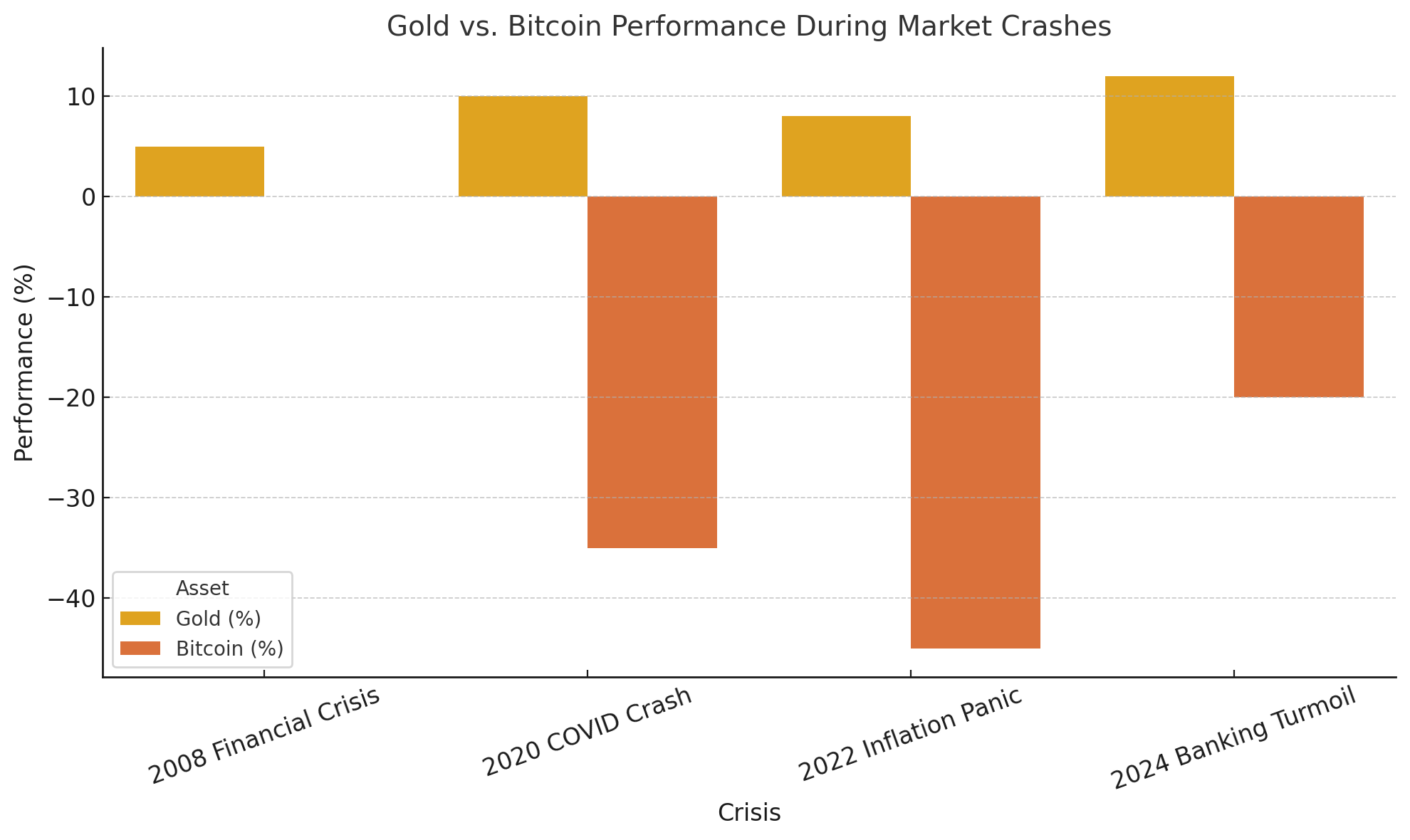
In the 2008 financial crisis, gold surged from around $700 to over $1,900 per ounce within three years. When everything else was collapsing — equities, real estate, jobs — gold acted as a hedge.
In today’s context, with inflation still sticky and central banks diversifying away from the U.S. dollar, the demand for gold remains strong. In fact, central banks have been accumulating gold at the fastest pace in over 50 years, especially in Asia and the Middle East.
Key advantages of gold:
- Long history of value retention
- Low volatility
- High liquidity
- Globally recognized and regulated
But gold isn’t perfect. It doesn’t yield interest or dividends, and in inflation-adjusted terms, its returns can be modest.
Bitcoin: The Digital Wild Card
Since its inception in 2009, Bitcoin has gained a cult-like following and a place in institutional portfolios. Its decentralized nature, capped supply of 21 million coins, and portability have earned it the title of “digital gold.”
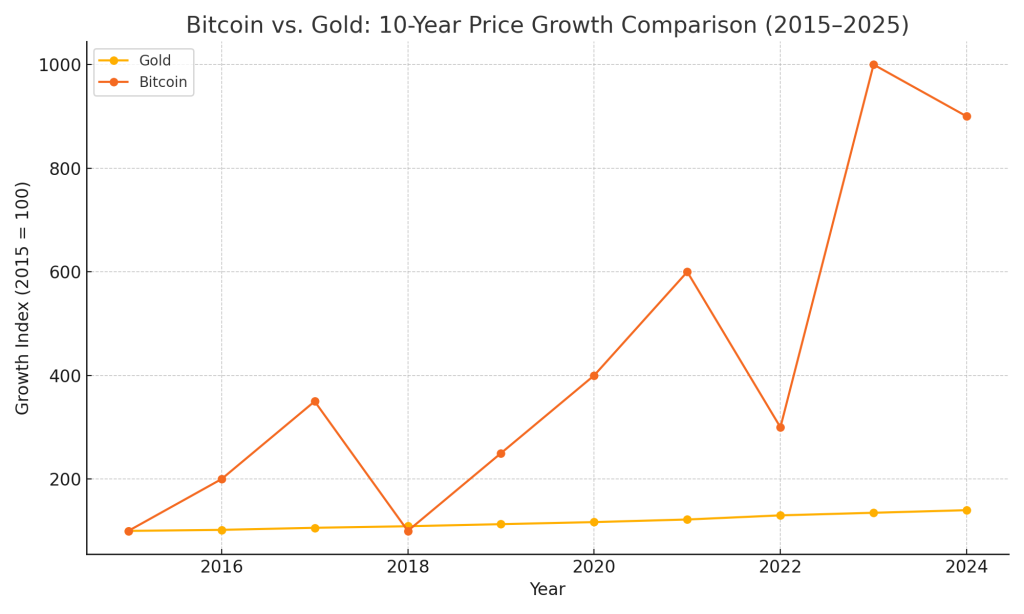
In the COVID-19 crash of March 2020, Bitcoin initially fell sharply along with the stock market — but then rebounded with a vengeance, skyrocketing from $5,000 to over $60,000 in just over a year.
The 2024–2025 period has brought renewed institutional interest, ETF approvals, and a stronger regulatory framework. Yet, volatility remains extreme. Bitcoin has seen multiple 70–80% drawdowns, making it a high-risk asset — even if the long-term trend remains bullish.
Key advantages of Bitcoin:
- High upside potential
- Strong scarcity and inflation resistance
- Ease of transfer and ownership
- Institutional and retail adoption growing
However, Bitcoin is still highly speculative. It’s influenced by regulation, public sentiment, and technological shifts. It also doesn’t behave like gold during crashes — in fact, it sometimes correlates with equities in panic selloffs.
Comparing Gold vs. Bitcoin in a Crisis
| Feature | Gold | Bitcoin |
| Age | Thousands of years | Since 2009 |
| Volatility | Low | High |
| Institutional Adoption | High | Growing |
| Scarcity | Moderate | Absolute (21M limit) |
| Use in Crisis | Historically proven | Mixed results |
| Portability | Low (physical) | Very high |
| Regulation | Mature | Evolving |
When the Crash Comes: Who Will Hold Better?
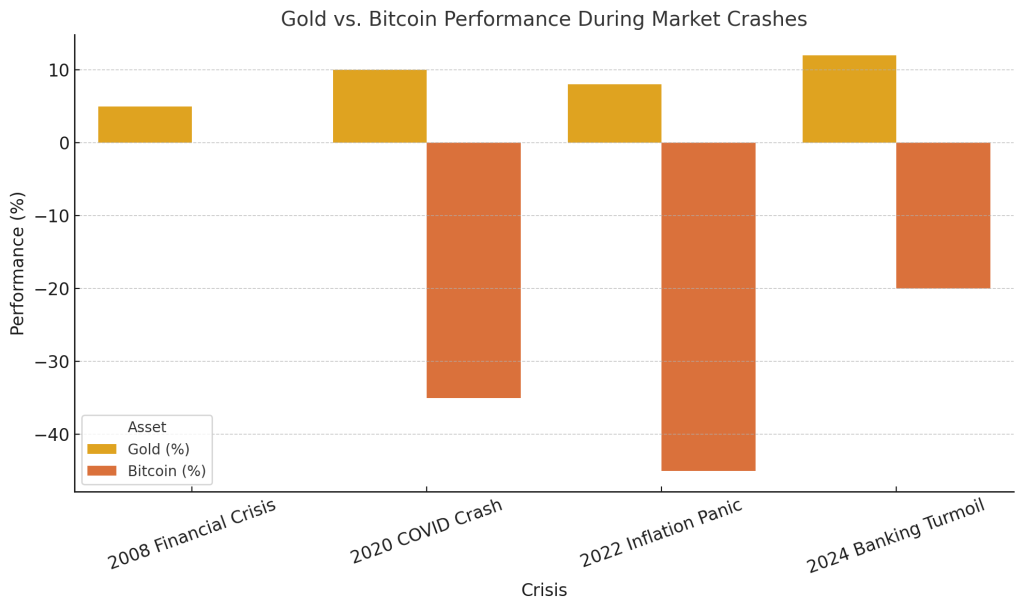
If the next market crash mirrors 2008 or 2020, gold may be the first to benefit. Institutional investors tend to flee into traditional safe havens when panic sets in. Bitcoin, on the other hand, may initially dip — as investors de-risk — before bouncing back if inflation becomes the dominant narrative.
However, in a true currency crisis or if fiat trust collapses, Bitcoin may outperform everything else — especially if capital controls or bank closures occur.
Therefore, some savvy investors hedge by holding both gold and Bitcoin, balancing stability with upside.
Macroeconomic Triggers to Watch
Both gold and Bitcoin respond to shifts in the macroeconomic environment — but often in different ways. Understanding these triggers can help investors time their allocations more intelligently.
1. Federal Reserve Policy (Interest Rates & Liquidity)
Gold tends to rise when the Federal Reserve lowers interest rates or signals a dovish stance. Lower real interest rates reduce the opportunity cost of holding non-yielding assets like gold. Bitcoin, too, thrives on liquidity expansions. In fact, many of Bitcoin’s bull runs have coincided with quantitative easing or stimulus programs.
2. Inflation and Currency Debasement
Persistent inflation — especially if higher than official numbers — is bullish for both gold and Bitcoin. Investors often rotate out of fiat assets when their purchasing power erodes. While gold is the time-tested inflation hedge, Bitcoin has increasingly been treated as a high-beta inflation hedge, especially among younger investors and institutions.
3. Banking System Instability
When banks wobble, gold shines. Historically, banking panics or bailouts (like 2008 or the 2023 U.S. regional bank crises) have sparked inflows into physical gold. In recent times, Bitcoin has begun playing a similar role. During the Silicon Valley Bank collapse, BTC surged by over 30% in a few days — as confidence in the banking system temporarily faltered.
4. Geopolitical Tension and War
Gold historically outperforms during war or military escalation. In contrast, Bitcoin may lag initially, as risk-off sentiment prevails. However, in countries experiencing capital flight (like Venezuela or Ukraine), Bitcoin has sometimes served as a lifeline for individuals.
Strategic Considerations: How Should You Allocate?
If you’re preparing your portfolio for a potential market crash, the decision between gold and Bitcoin isn’t binary. Many investors are choosing to own both, depending on their risk tolerance, time horizon, and conviction in decentralization.
Here’s a simplified breakdown:
| Investor Profile | Gold Allocation | Bitcoin Allocation |
| Conservative | 10–20% | 0–2% |
| Balanced | 10–15% | 2–5% |
| Aggressive | 5–10% | 5–15% |
| Crypto Maximalist | 0–5% | 25–100% |
Note: These are not financial recommendations, but illustrative ideas based on common portfolio strategies.
Why Not Both?
If your goal is to protect wealth and seize opportunity, then holding both gold and Bitcoin offers diversification. Gold protects against central bank policy mistakes, war, and credit crises. Bitcoin is a hedge against monetary debasement, censorship, and systemic risk in an increasingly digital world.
You don’t have to choose just one. Think of them as two generations of monetary insurance — one analog, one digital.
MoreThoughts: Before the Crash, Be Ready
No one can predict exactly when the next crash will come — but history tells us it’s inevitable. Whether triggered by rising debt, a credit event, or geopolitical escalation, crashes reward preparation.
Gold and Bitcoin each have a role to play in that preparation. If you’re concerned about the long-term value of your money, it’s worth asking: Which will perform better when everything else fails?
In 2025 and beyond, many investors are no longer asking “Should I buy gold or Bitcoin?” but rather — “How much of each should I own?”
Historical Performance: Gold vs. Bitcoin in Crashes
Understanding how each asset performed during past financial crises can offer important clues about what to expect in the next one.
2008 Financial Crisis: Gold Outperformed, Bitcoin Was Absent
- Gold rose nearly 23% from its 2008 low to its 2011 peak.
- Bitcoin hadn’t yet launched — the Bitcoin whitepaper was published in late 2008, and BTC only became tradable in 2010.
- Gold proved its traditional role as a safe haven during systemic banking and real estate collapse.
2020 Pandemic Crash: Bitcoin Fell First, Then Soared
- Gold quickly rebounded after a short dip in March 2020, eventually reaching an all-time high of over $2,000 later that year.
- Bitcoin plunged ~50% in March 2020 but staged a massive recovery, reaching $69,000 by late 2021 — up nearly 15× from its 2020 low.
- This cemented BTC as a high-volatility risk asset with asymmetric upside in a stimulus-fueled world.
2022–2023 Inflation Shock and Rate Hikes: Mixed Signals
- Gold remained relatively stable, hovering between $1,700 and $2,000.
- Bitcoin dropped over 75% from its 2021 peak, falling below $16,000 during FTX and Luna collapses.
- In 2023, as interest rate hikes slowed, both gold and Bitcoin rebounded, showing that they react strongly to liquidity cycles.
Takeaway:
- Gold tends to perform well during early crisis phases — especially when fear and capital preservation dominate.
- Bitcoin shines in the aftermath, when stimulus, devaluation, or distrust of central authorities fuels demand for alternative stores of value.
Bitcoin and Gold Price Outlooks: What’s Ahead?
Bitcoin (BTC) Outlook – 2025–2026
- Many analysts anticipate a continuation of Bitcoin’s post-halving cycle, with possible highs above $100,000 depending on macro conditions.
- However, a market crash could temporarily bring BTC down below $50,000 again — especially if liquidity dries up.
- Bitcoin’s institutional adoption, ETF flows, and global monetary tightening will heavily influence the path.
Gold Outlook – 2025–2026
- As of mid-2025, gold remains above $3,300 and is near all-time highs.
- If inflation persists and central banks begin to cut rates, gold could climb to $3,600–$4,000 within 12–18 months.
- Rising sovereign debt, de-dollarization, and geopolitical risk all support a bullish gold thesis.
Key Questions to Ask Yourself Before Investing
To decide which asset deserves more weight in your portfolio, ask:
- ✅ Do I want stability and long-term preservation? → Lean more toward gold.
- ✅ Do I want asymmetric growth potential and decentralization? → Lean more toward Bitcoin.
- ✅ Do I believe central banks will continue printing money or lose control of inflation? → Own both.
- ✅ Am I prepared for high volatility and long drawdowns? → Then Bitcoin may fit your strategy.
Actionable Steps You Can Take Today
- Evaluate your current portfolio exposure. Are you overexposed to fiat, equities, or real estate?
- Set allocation targets. For example: 10% gold, 5% Bitcoin — adjust based on risk tolerance.
- Use dollar-cost averaging (DCA). Both gold and Bitcoin can be volatile — averaging in reduces emotional decision-making.
- Secure your assets. Use hardware wallets for Bitcoin and secure vaults or ETFs for gold.
- Stay informed. Subscribe to financial news and keep an eye on Fed policy, CPI releases, and global debt indicators.
Buy Gold, Buy Bitcoin — But Buy With Purpose
The next crash may not look like 2008, or 2020. It may come from a debt implosion, a currency crisis, or something entirely unexpected. The only certainty is that uncertainty is increasing.
Gold and Bitcoin are two of the few assets that don’t rely on someone else’s promise. They’re independent, scarce, and increasingly critical in a world of monetary distortion and geopolitical fragmentation.
So don’t wait until headlines scream panic. Prepare now — calmly, wisely, and with conviction.