As we are in the second half of 2025, uncertainty casts a long shadow across global markets. Inflation flirts with stubborn highs, the Federal Reserve stands at a crossroads, and geopolitical fault lines—especially between Israel and Iran—threaten to disturb the fragile equilibrium. In this climate of turmoil, two assets consistently emerge as safe-haven favorites: gold and Bitcoin. Yet, as digital natives argue, “Bitcoin is digital gold”—can it truly stand toe-to-toe with the centuries-old refuge of bullion?
This article explores gold’s resurgence, Bitcoin’s evolving role, and ultimately offers investors a nuanced answer: which is the superior safe haven in today’s volatile world?
A Tale of Two Assets: Nature and Performance
Gold and Bitcoin share high-level similarities—finite supply, no counterparty risk, and hedging appeal—but their journeys diverge sharply under scrutiny.
1. Gold: The Timeless Refuge
Nothing symbolizes stability like gold. As of June 2025, it’s surged nearly 30%, trading above $3,400 per ounce, propelled by inflation fears, central-bank gold buying, and geopolitical tremors in the Middle East morpher.com+3finextra.com+3entrepreneur.com+3barrons.com. Its historical role as a crisis asset remains intact.
2. Bitcoin: The Digital Challenger
Bitcoin, the poster child of crypto, is trading near $107,000, buoyed by institutional inflows and more favorable regulation coindcx.com+7gate.com+7fingerlakes1.com+7. Its maturation shows—volatility has declined, and its 100-day moving average now offers a stable base. Yet, its responses to rapid market shifts reveal a complex identity.
Crisis Activation: Gold Reacts; Bitcoin Hesitates
To assess safe-haven credentials, nothing is more illustrative than testing how each asset responds to sudden shocks. From mid-June, tense headlines between Israel and Iran offer a clear case.
- When Israel struck Iran’s Natanz facility on June 13, gold rallied over 1%, touching $3,450, while U.S. gold-futures firmed wsj.com+2finextra.com+2economictimes.indiatimes.com+2wsj.com+11reuters.com+11fnlondon.com+11.
- Bitcoin, conversely, fell 2%, suffering from its correlation to equities and vulnerability to risk-off sentiment arxiv.org+9entrepreneur.com+9marketwatch.com+9.
Peter Schiff, a well-known gold advocate, pointed to this disparity as evidence that “Bitcoin does not function like gold in times of crisis” fxempire.com+15ainvest.com+15economictimes.indiatimes.com+15.
🧭 Charting the Differences: A Comparative Table
| Feature | Gold | Bitcoin |
| Crisis Reaction | Consistently upward | Often drops during sudden shocks economictimes.indiatimes.com+4reuters.com+4ccn.com+4 |
| Volatility | ~15% annual | ~38–50% annual, though declining |
| Institutional Adoption | Central-bank reserves, ETFs | Growing treasury holdings, U.S. Strategic Bitcoin Reserve |
| Inflation Hedge | Proven, centuries | Emerging, tied to fiat distrust; newer than gold |
| Liquidity | Extremely liquid | Liquid, but thinner during stress |
| Regulation/Custody | Easy, insured, regulated | Improving, institutional-grade infrastructure |

The Institutional Angle: Trust and Scale
A striking shift in recent months is institutional (and national) trust in both assets.
- Gold remains central: central banks worldwide (especially China, India, Turkey) have added over 1,000 tonnes annually economictimes.indiatimes.com+15ft.com+15marketwatch.com+15.
- Bitcoin has won unprecedented support:
- The U.S. Treasury now holds a “Strategic Bitcoin Reserve” following an executive order by President Trump en.wikipedia.org+1en.wikipedia.org+1.
- MicroStrategy—now known as Strategy—continues aggressive accumulation: they recently issued preferred shares to buy 10,100 BTC further expanding a treasury already exceeding 592,000 BTC barrons.com.
While both major institutions and governments have embraced Bitcoin, gold’s central-bank adoption remains deeper and more global—especially as a currency hedge.
Inflation and the Dollar: A Common Backdrop
Both gold and Bitcoin derive part of their safe-haven narrative from their status as alternatives to fiat:
- The U.S. dollar has slumped ~9% year-to-date, weakening the buying power of reserves morningstar.co.uk+7marketwatch.com+7entrepreneur.com+7.
- As said by FXEmpire, Bitcoin’s rally—around +13% YTD—is largely a dollar hedge fxempire.com.
- Gold too benefits: a weaker dollar makes gold cheaper for foreign buyers, supporting higher prices.
However, gold retains a proven ability to bounce under inflationary pressure, while Bitcoin remains tested as a long-term inflation hedge.
Forecasting Each in 2025: Divergence Ahead
What might the rest of 2025 hold? Predictions vary, but certain trends stand out:
🌟 Gold Outlook
- BofA’s Ed Yardeni forecasts gold topping $4,000 by year-end and potentially climbing to $5,000 in 2026 barrons.com+1entrepreneur.com+1barrons.com.
- That said, Citi warns gold could dip to $2,800–$3,000 if global growth picks up and tensions ease reuters.com.
💻 Bitcoin Outlook
- Technical models show Bitcoin holding strong above the 100-day MA around $105,500, with upside potential to $120,000–$160,000 depending on ETF flows and halving momentum gate.com+1coindcx.com+1.
- Some bullish analysts, like those at Changelly, anticipate BTC reaching $138,000 by June, possibly $150,000+ by year-end changelly.com.
- Conversely, critics stress Bitcoin’s failure during crises may limit its hedge appeal, positioning it more as a high-risk, high-reward asset wsj.com.
The Correlation Conundrum: Gold, Bitcoin & Equities
In an unexpected twist, 2025 has seen gold, stocks, and Bitcoin moving in unison . Typically, investors expect gold to diverge from equities when volatility rises. The current convergence reflects a broken correlation between traditional assets, amplifying the divergence between gold and Bitcoin:
- Gold: prices reflect direct fear and central bank signals.
- Bitcoin: appears more tied to liquidity and technology-driven risk-on sentiment.
Strategic Takeaways: Who Wins?
So where does that leave us? Here’s a balanced view:
- Gold remains the clear safe-haven benchmark:
- Crisis-tested, globally recognized, central-bank-backed, and reliably responsive.
- Its slower price action means less volatility and reliable hedging.
- Bitcoin is a new kind of asset:
- Exhibits impressive upside in stable environments and growing institutional frameworks.
- But falls short during panic episodes, confirming its status as speculative rather than crisis-tested.
Portfolio Strategy
A smart play may be a combination:
- Gold (e.g., physical, GLD) for stability and crisis protection.
- Bitcoin (via ETFs or hardware wallets) for growth during liquidity surges.
This dual approach balances the depth of gold’s foundation with the upside potential of Bitcoin’s new frontiers.
Where to From Here?
- Watch the Middle East: Any new flare-ups support gold—Bitcoin may dip.
- Monitor the Fed: A dovish tilt likely lifts both; a hawkish pivot may weigh on both, but Bitcoin more due to risk-off.
- Keep an eye on BTC infrastructure: halving cycles, regulatory clarity, passes from instruments like the Strategic Reserve.
- Adjust weightings:
- In calm, risk-on phases: tilt slightly more toward Bitcoin.
- In turbulent conditions: lean heavily into gold.
Final Verdict
In mid‑2025, gold remains the reigning safe haven: crisis-tested, liquid, global, and central-bank trusted. Bitcoin, though maturing fast, still plays second fiddle during fear-driven episodes, showing more correlation to equities than to traditional refuge assets.
Yet, to dismiss Bitcoin entirely would be to ignore its dramatic ascent through institutional adoption, central-bank pilot programs, and technological maturity. The question isn’t “Is Bitcoin gold?” but rather, “How can both serve different roles in a modern investor’s armory?”
By embracing gold’s steady refuge and Bitcoin’s asymmetric upside, the savvy investor in 2025 can harness the best of both worlds.
Suggested resource setup & follow-ups
- Embed gold charts from TradingView showing $3,400–$3,500 levels.
- Include BTC technical snapshot, with 100-day MA support at $105k.
- CTA: Build your own “Safe Haven portfolio”—balancing metal, fiat, and crypto.
Let me know if you’d like slides, infographics, or more detailed tables on historical crisis performance.
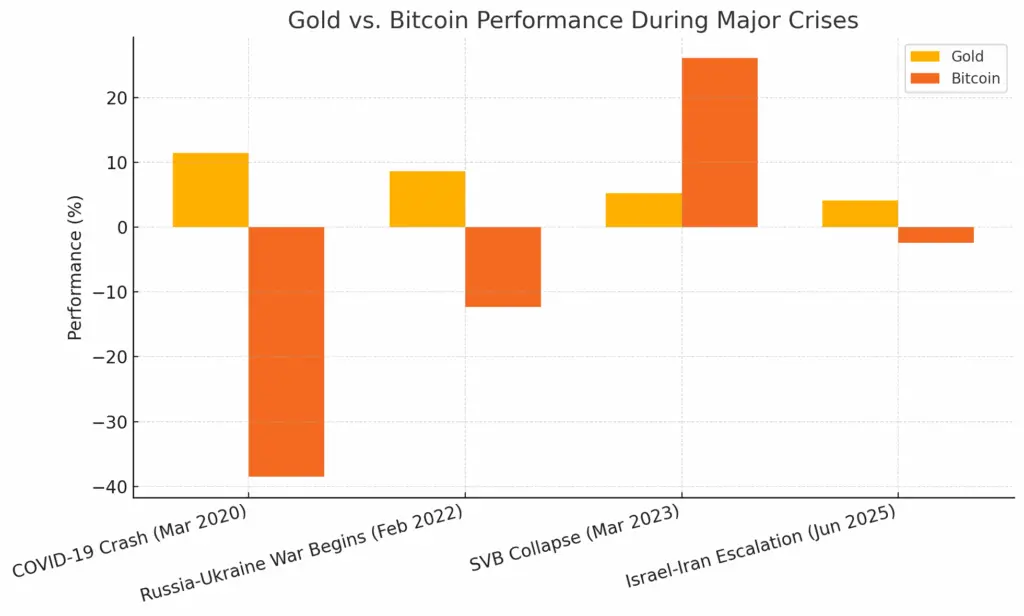
Here’s the first infographic: a comparison of Gold vs. Bitcoin performance during major global crises. It clearly shows how gold has been a more consistent safe haven, while Bitcoin shows higher volatility and occasional divergence.
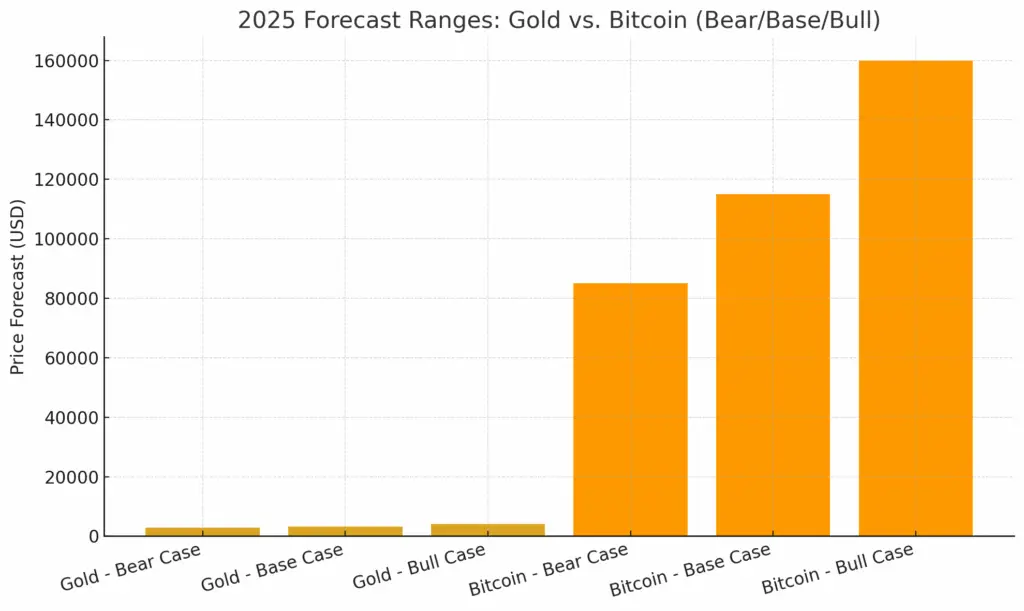
Here’s the second infographic: a 2025 forecast comparison showing bear, base, and bull scenarios for both Gold and Bitcoin. It visually illustrates the higher upside (and wider uncertainty) range of Bitcoin compared to the more stable range expected for gold.
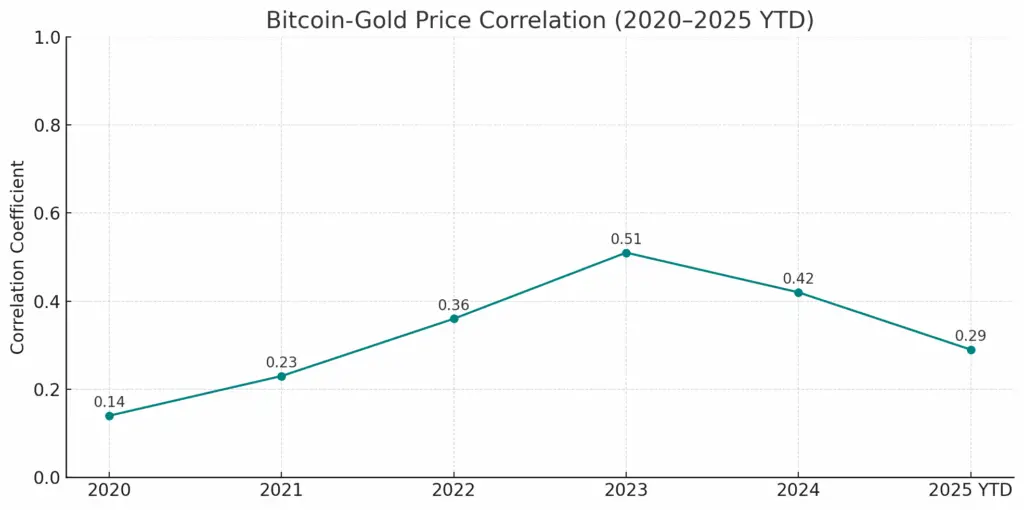
Here’s your third infographic: a Bitcoin–Gold price correlation trend from 2020 to 2025 YTD. It shows that while correlation peaked during mid-cycle liquidity events, it’s weakening again in 2025—underscoring their diverging roles in investor portfolios.