As inflation pressures persist and geopolitical tensions remain unpredictable, high-net-worth investors face an increasingly urgent question: where should wealth be parked to survive and grow over the next two years? From Wall Street to Zurich, from private wealth offices to crypto-native funds, a growing divide is emerging in asset allocation. Gold, Bitcoin, and cash are the three main vehicles being considered by those who anticipate major shifts in the global economy. But which one leads the way in 2025–2027?
This article explores the psychology, performance, and risk tradeoffs between these three asset classes. We will examine how the rich are positioning themselves now, what historical patterns tell us, and what investors can learn from their moves.
Why These Three? Why Now?
The choices of gold, Bitcoin, and cash aren’t arbitrary. Each represents a fundamentally different approach to risk, liquidity, and worldview:
- Gold: A timeless store of value in times of uncertainty, inflation, or systemic collapse.
- Bitcoin: A speculative but potentially explosive hedge against fiat devaluation and monetary debasement.
- Cash: Flexibility and short-term safety, especially in high-interest environments.
In the post-COVID world, with central banks having printed trillions and interest rate cycles beginning to reverse, these three assets symbolize three mindsets: preservation, innovation, and optionality.
Historical Returns: A Look Back Before Looking Forward
From 2020 to 2023:
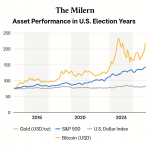
- Gold rose from ~$1,500 to over $2,400 at its 2024 peak (+60%).
- Bitcoin surged from ~$7,000 in early 2020 to a high of $69,000 in late 2021, then corrected sharply before recovering to over $60,000 in 2025.
- Cash (USD money markets or T-bills) offered little return until 2022, when rising interest rates made 4–5% annual yields possible.
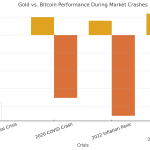
Each of these assets had their moment. In crisis, cash was king. In inflation, gold returned to glory. In loose monetary policy, Bitcoin exploded.
But looking ahead, the key is this: what comes next?
How the Wealthy Are Allocating in 2025
Based on hedge fund reports, private banking outlooks, and recent asset flows:
- Gold allocations are rising among conservative high-net-worth investors, especially in Europe and Asia.
- Bitcoin exposure is increasing in younger wealth circles and tech-driven funds, often in the 1% to 5% range of total assets.
- Cash is still favored for optionality, especially in the form of short-term Treasuries.
Notably, multi-asset portfolios managed by Swiss banks or U.S. family offices often now include all three.
Comparative Risk Profile
| Asset | Inflation Hedge | Liquidity | Volatility | Institutional Support |
| Gold | Strong | High | Low | Strong |
| Bitcoin | Very Strong (theoretical) | Medium | Very High | Growing |
| Cash | Weak | Very High | Very Low | Strong |
Why the Rich Use Cash Differently
While the average investor sees cash as a savings tool, the rich often use it as a positioning weapon. It’s used to:
- Wait for buying opportunities
- Reduce volatility
- Act as collateral for credit lines
Ultra-wealthy portfolios tend to keep 10–30% in cash equivalents during late-cycle uncertainty, not because they expect great returns, but because opportunity is often born in downturns.
Bitcoin: Now a Strategic Asset?
Bitcoin has transitioned from fringe to strategic. BlackRock, Fidelity, and JPMorgan now offer Bitcoin-related funds. Even some pension funds allocate a small portion.
The narrative has shifted from speculation to:
- Digital scarcity in an inflationary world
- Cross-border liquidity in geopolitical uncertainty
- Tech hedge in an AI-automated economy
Wealth managers now view Bitcoin like they once viewed gold in the 1970s—volatile, but not dismissible.
The Strategic Roles of Each Asset
🟡 Gold: The Time-Tested Hedge
Gold continues to be a cornerstone of wealth preservation. Despite some volatility, it’s still seen as the ultimate hedge against:
- Currency devaluation
- Geopolitical risk
- Inflation surprises
In 2024–2025, central banks — especially from China, India, and the Middle East — have been accumulating gold at a historic pace. The World Gold Council reported record sovereign gold buying in 2023, and that trend is continuing into 2025. This is not just about diversification — it’s a statement of distrust in fiat currency stability, especially the U.S. dollar.
For high-net-worth individuals (HNWIs), gold offers:
- No counterparty risk
- Privacy and discretion
- Long-term purchasing power
But the downside is clear: gold doesn’t produce yield. It’s a store of value, not a growth asset. And in deflationary periods or rate-hike cycles, it can underperform.
🟠 Bitcoin: The New Digital Hedge or Just Speculation?
Bitcoin’s story from 2020 to 2025 is one of normalization. No longer just a fringe asset, Bitcoin is now part of many institutional portfolios, family offices, and retirement plans.
Here’s why the rich are increasingly allocating small but deliberate slices of their portfolios to BTC:
- Asymmetric upside — Bitcoin has a capped supply of 21 million coins. That fixed ceiling makes it attractive in a world of money printing and ballooning debt.
- Decentralized and global — It’s not bound to any one nation-state or central bank.
- Liquidity and portability — A few seed words can carry billions in value across borders — useful for those protecting intergenerational wealth.
Yet it comes with major caveats:
- Volatility remains high — Bitcoin can drop 40% in a matter of weeks.
- Uncertain regulation — Despite growing acceptance, governments still pose a risk.
- Correlations shift — While often dubbed “digital gold,” Bitcoin has at times moved with risk-on tech stocks.
Still, the long-term trend shows whales and institutional players buying the dips — not fleeing.
💵 Cash: Security, Liquidity — and Hidden Risk?
At first glance, holding cash may seem like the most prudent move, especially in times of uncertainty. And indeed, many wealthy investors — including top hedge funds — have increased their short-term T-bill and money market allocations.
Advantages of cash:
- Zero volatility
- Complete liquidity
- Optionality — You can buy when assets get cheap
But the problem is hidden:
- Inflation erosion — Even modest inflation destroys purchasing power over time
- Yield mismatch — While 2023–2025 saw higher interest rates (e.g., 4–5% T-bills), that may fall in late 2025 or 2026
- Missed growth — Sitting in cash means missing out on bull runs
Thus, for the rich, cash is often a temporary strategic move — not a permanent allocation. It’s dry powder.
Next section will cover real-world allocation patterns, including:
- How billionaires and top hedge funds are splitting exposure across these three assets
- What we can learn from institutional filings and portfolio disclosures
- When and why they pivot between gold, crypto, and cash
How the Wealthy Allocate: Real Portfolios, Real Signals
For everyday investors, portfolio advice is often generic. But for ultra-high-net-worth individuals (UHNWIs), the strategy is more dynamic and tailored — often involving private wealth managers, macro hedge funds, and tax-advantaged structures. So how are they allocating to gold, Bitcoin, and cash right now?
1. Gold: Often 5–10% of Total Wealth
Despite being a legacy asset, gold remains a consistent slice of portfolios — especially for risk-conscious billionaires and sovereign wealth funds.
Examples:
- Ray Dalio (Bridgewater Associates): Advocated for holding 5–10% of a portfolio in gold, especially when currencies are being debased.
- Stanley Druckenmiller: Has rotated in and out of gold based on macro trends, using it as a hedge when equities seem overvalued or geopolitics heat up.
- Middle Eastern sovereign wealth funds: As of 2024–2025, many have increased allocations to physical gold and mining stocks amid oil price uncertainty and dollar volatility.
Trend: Wealthy investors don’t always chase gains with gold — they use it to protect what they’ve already built.
2. Bitcoin: Strategic Slice (1–5%) with Growth Potential
Despite volatility, many HNWIs now treat Bitcoin as a venture-style asset: small allocation, massive upside. It’s no longer considered irresponsible to hold crypto — in fact, not holding it may be seen as a missed opportunity.
Examples:
- ARK Invest’s flagship ETF continues to maintain a double-digit crypto allocation.
- MicroStrategy’s Michael Saylor has made Bitcoin a central part of corporate and personal treasury strategy.
- Family offices in Singapore, Switzerland, and New York have been increasing BTC exposure, especially since the approval of U.S. Bitcoin ETFs in early 2024.
Trend: Most wealthy investors won’t go “all in,” but many now see Bitcoin as a call option on monetary disruption — a bet that pays off if fiat credibility collapses.
3. Cash: 10–30% for Flexibility and Optionality
Cash is underrated. While it doesn’t grow wealth, it gives the rich something just as powerful — control.
Many hedge fund managers and UHNWIs went into 2025 with larger-than-normal cash positions due to:
- Overheated equities
- Tightening liquidity in real estate
- Fear of crypto pullbacks
Now, as the second half of 2025 begins, some are starting to rotate back in. But make no mistake: cash is not an end goal — it’s a waiting room for better opportunities.
Examples:
- Warren Buffett’s Berkshire Hathaway held over $150 billion in cash in 2024–2025, waiting for “fat pitches.”
- Bridgewater and other macro funds kept high cash buffers in early 2025 due to rate uncertainty and geopolitical tail risks.
Trend: The rich use cash as a position — not a place to hide.
Portfolio Allocation by Risk Profile (Gold, Bitcoin, Cash) for Conservative, Balanced, and Aggressive investors.

Emerging Pattern: The “Barbell” Strategy
Many wealth managers now describe their client strategy as a barbell approach:
- One side is defensive: gold, short-term cash, treasuries
- The other side is asymmetric risk: Bitcoin, venture assets, innovation stocks
This balances capital protection with upside participation. And it helps explain why we’re seeing rising inflows into both money market funds and crypto ETFs at the same time.
Scenarios for 2025–2027: What If the Market Turns?
No portfolio exists in a vacuum. What the rich are buying depends heavily on what they think is coming next — and they don’t all agree. But most of them build their allocations around macro scenarios. Here are the three dominant outlooks for the next 12–24 months, and how they affect gold, Bitcoin, and cash positioning:
Scenario 1: Recession and Rate Cuts (Soft or Hard Landing)
- Gold: Likely to rise as interest rates fall and central banks resume easing. Historically, gold performs well when real yields drop.
- Bitcoin: Could benefit from liquidity injections, especially if a dovish pivot sparks a new wave of risk-on behavior.
- Cash: Decreases in value due to inflation and lower yields. Opportunity cost of holding cash rises.
Investor Action: Shift from cash into assets like gold and Bitcoin that preserve or grow purchasing power in an easing cycle.
Scenario 2: Stagflation or Sticky Inflation
- Gold: Historically one of the top-performing assets in stagflation (see 1970s). Real asset hedges become highly desirable.
- Bitcoin: Mixed. BTC may hold or rise depending on whether it’s seen as digital gold or a speculative asset — sentiment-sensitive.
- Cash: Destroyed by inflation. Purchasing power erodes quickly unless moved into higher-yielding or inflation-resistant instruments.
Investor Action: Rebalance toward gold and real assets. Bitcoin allocations increase if it’s viewed as a scarce asset immune to central bank manipulation.
Scenario 3: Strong Economy + Resilient Stocks
- Gold: Likely underperforms, though may hold steady due to geopolitical tensions or central bank buying.
- Bitcoin: Could thrive — viewed as tech-aligned growth play in bullish environments, especially if risk appetite returns.
- Cash: Rotated into equities, alternatives, or income-generating assets.
Investor Action: Reduce cash, increase exposure to growth-oriented vehicles including crypto ETFs and selective equities. Gold becomes a smaller slice.
A bar chart showing the estimated total returns for Gold, Bitcoin, and Cash from 2020 to 2023.

What the Smartest Allocators Are Doing Now
Big institutions and ultra-wealthy investors are not betting on just one scenario. Instead, they’re weighting probabilities and preparing for all of them. Common strategies:
- Diversification across “anti-fragile” assets (gold, Bitcoin, hard real estate)
- Staggered entries into Bitcoin to avoid FOMO at the top
- Holding cash temporarily but with clear deployment plans
- Using gold-backed or crypto-backed loans to unlock liquidity without selling
They’re playing defense and offense simultaneously — aiming to protect wealth while positioning for asymmetric upside.
Final Takeaways: What Should You Do?
Even if you’re not ultra-wealthy or managing a nine-figure family office, the logic behind their strategies applies just as well. Here’s how to adapt the same thinking to your portfolio:
1. Define Your Objective First
Ask yourself:
Do I want to preserve wealth, grow it steadily, or speculate for outsized returns?
- If preservation is your goal → gold and some cash are safer anchors.
- If growth is your focus → Bitcoin and gold both offer potential upside, especially in a mixed or inflationary environment.
- If speculation excites you → Bitcoin and even altcoins offer asymmetric risk-reward, but position sizes must be carefully managed.
2. Allocate Based on Macro Risk, Not Headlines
Don’t overreact to day-to-day news. Instead, model your portfolio for broader possibilities like:
- A surprise Fed pivot
- A war escalation or energy crisis
- Continued AI-fueled equity booms
The rich don’t wait for confirmation — they allocate ahead of events. Their portfolios often reflect where the world might be going, not where it has already been.
3. Balance Agility With Conviction
High-net-worth investors don’t just “set and forget.” They:
- Review positioning quarterly
- Hedge downside using inverse ETFs, options, or cash
- Rebalance into strength (e.g., trimming Bitcoin after a strong run) or weakness (e.g., adding gold when it pulls back)
Even if you can’t do this at their scale, the principle remains: stay nimble, but stay in the game.
A Simple Template You Can Use
Let’s say you’re managing a $100,000 portfolio in mid-2025. Here’s how three sample allocations could look, depending on your view of the world:
| Strategy | Gold | Bitcoin | Cash |
| Defensive | 50% | 10% | 40% |
| Balanced | 30% | 30% | 40% |
| Opportunistic | 20% | 60% | 20% |
(We can also visualize this as a pie chart — let me know if you’d like one.)
Conclusion: Don’t Follow the Rich — Think Like Them
By the time most headlines report “What billionaires are buying,” it’s too late. The advantage lies in thinking like them early:
- Scan the macro backdrop
- Weight your expectations for 2025–2027
- Position across gold, Bitcoin, and cash depending on your risk and timing preferences
This isn’t about copying trades — it’s about adopting the same mindset of strategic foresight and active positioning.
Because in today’s market, waiting in cash is a choice, but not always a good one.