In 2025-2026, with financial markets in flux and geopolitical risks mounting, investors are increasingly asking: Should I buy crypto, invest in the stock market, or trust in gold? The old rules are breaking down, and the “safest” choice isn’t always the one that performs best.
This guide dives deep into the real performance, volatility, and strategic role of each asset class — cryptocurrency, equities, and gold — to help you decide where your money belongs in 2025–2026.
The Investment Landscape in Mid-2025: A Year Like No Other
We’re halfway through a year that has seen:
- Bitcoin breaking above $100,000, then retreating
- The Dow Jones near record highs, despite signs of economic slowdown
- Gold surging above $3,400, reaching all-time highs amid central bank buying
This convergence of bullish signals from all three markets makes asset allocation more challenging — and more important — than ever.
Crypto in 2025: High Returns, High Risk, High Adoption
Upside Potential
Bitcoin has more than doubled from its 2023 lows. Ethereum is back above $4,000. New crypto ETFs are making headlines, and institutional investors are finally treating crypto as a real asset class.
- Bitcoin YTD (Jan–July 2025): +62%
- Ethereum YTD: +51%
- Solana, Avalanche, and Layer 2 tokens: +30% to +80%
The Bitcoin halving in April 2024 created a classic post-halving rally. Some analysts still believe BTC could reach $140,000–$160,000 by early 2026. But others warn that crypto markets remain deeply cyclical and prone to 40–60% drawdowns — even in bull markets.
Risks and Volatility
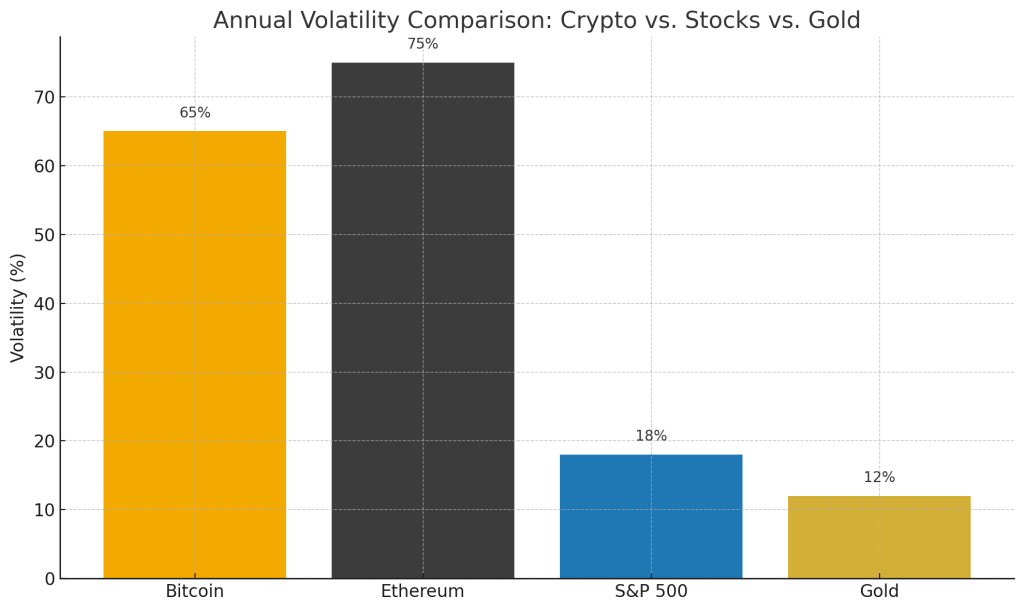
Crypto remains the most volatile asset class, with:
- Sharp intraday swings (+/- 5–10%)
- Regulation risks (especially in the U.S. and EU)
- Tech failures or hacks in smaller projects
- Herd-like retail behavior driven by hype
If you invest in crypto, expect high risk — and plan your position sizing carefully.
Stocks in 2025: Surprisingly Resilient, But Caution Ahead
Current Trends
Despite inflation concerns, tech sector overvaluation, and softening consumer data, U.S. stock markets remain strong:
- S&P 500 YTD (2025): +9.5%
- Nasdaq YTD: +11.3%
- Dow Jones: Near all-time highs around 40,000
Nvidia, Microsoft, and Apple are driving returns — but many investors fear a Fed policy misstep or a recession could trigger sharp corrections in late 2025 or 2026.
Valuation vs. Risk
Compared to crypto, stocks offer:
- Lower volatility
- Stable dividends (for some sectors)
- Stronger institutional protection
But U.S. stocks in particular appear overpriced by historical metrics. Price-to-earnings (P/E) ratios for many tech companies are at multi-decade highs — and margin compression is now visible in several earnings reports.
Let’s cover gold’s role in 2025 portfolios, the smart way to balance these three assets, and how different investors (young, conservative, growth-focused) can make allocation decisions. We cover gold, its role, and the psychological impact it has in this environment. Plus, the deep comparison between crypto, stocks, and gold by focusing now on gold’s performance, role, and relevance in 2025–2026.
Gold in 2025: The Silent Powerhouse of Global Wealth
Why Gold Is Booming Again
For centuries, gold has been a safe haven in times of uncertainty — and 2025 is no exception. After hovering below $2,000 for most of 2023, gold has surged past $3,400 per ounce in mid-2025, breaking historical records.
This rally isn’t driven by retail demand or jewelry. It’s led by:
- Central bank buying, especially by China, Russia, Turkey, and India
- Institutional reallocation away from fiat currencies
- Rising global debt and inflation fears
- A growing distrust in Western fiscal stability and U.S. dollar dominance
YTD Performance
- Gold YTD (2025): +24%
- Silver YTD: +30%
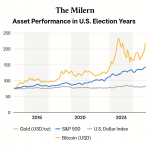
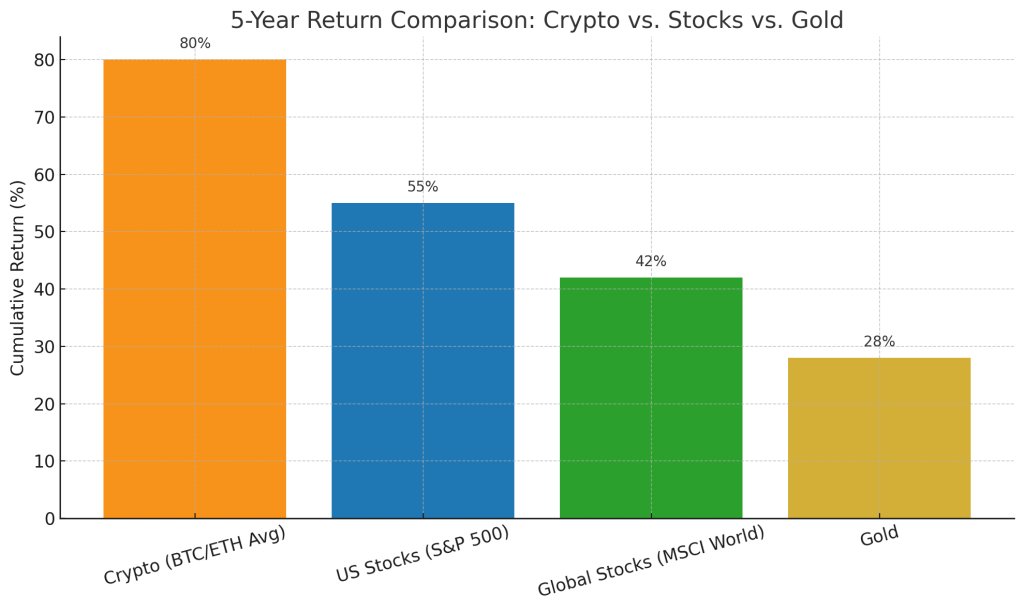
- Gold vs. S&P 500 (5-year return): Gold has outperformed the S&P in inflation-adjusted terms since 2020
Gold’s slow, methodical rise isn’t exciting — but in an age of volatility, it offers reassurance, preservation, and policy-proof wealth.
The chart “5-Year Return Comparison: Crypto vs. Stocks vs. Gold”
Gold as a Psychological and Strategic Asset
Gold does three things well:
- Preserves purchasing power over long periods
- Diversifies portfolios during crises (when stocks and crypto fall together)
- Builds intergenerational wealth, particularly in emerging markets
Even among younger investors who favor Bitcoin or Ethereum, there’s a growing trend to hold 5–10% in physical gold or gold-backed ETFs — as a long-term hedge.
The Role of Each Asset in a Balanced Portfolio (2025–2026)
Let’s break it down:
| Asset Class | Strengths | Weaknesses | Ideal Use |
| Crypto | High upside, global access, innovation exposure | High volatility, speculative, regulatory risk | Growth allocation (10–30% for risk-tolerant investors) |
| Stocks | Proven long-term growth, dividend income, institutional coverage | Can crash with macro shocks, overvalued in some sectors | Core portfolio anchor (40–60%) |
| Gold | Inflation hedge, safe haven, historically trusted | No yield, underperforms in booming markets | Hedge allocation (5–15%) |
This is where personal goals and risk tolerance matter most. A 25-year-old investor may load up on crypto and tech stocks. A 60-year-old might prioritize gold and dividend-paying blue chips. And a well-diversified portfolio will include all three — just in different proportions.
Now, let us explore practical portfolio strategies, example allocations for different investor types, and what to expect in late 2025 and early 2026. We are now looking into portfolio strategies and real-world allocations combining crypto, stocks, and gold for different types of investors in 2025–2026.
Building a Smart Portfolio in 2025–2026: Sample Allocations by Risk Type
Investors are no longer debating whether to include crypto, stocks, or gold — the real question is how much of each, and in what mix.
Below are realistic allocation examples based on risk tolerance and investment horizon:
Conservative Investor (Near Retirement, Low Risk Tolerance)
- 60% Stocks – Large-cap dividend stocks, value ETFs, S&P 500
- 30% Gold – Physical gold, GLD ETF, central-bank-style reserve
- 10% Crypto – Primarily Bitcoin, some Ethereum via ETF or custodial wallet
Goal: Preserve capital, hedge inflation, generate modest growth
Moderate Investor (Balanced, 10–20 Year Horizon)
- 50% Stocks – Growth + value mix, international exposure
- 25% Gold – Both inflation hedge and geopolitical risk hedge
- 25% Crypto – 70% BTC, 30% ETH or layer-1 altcoins with strong use case
Goal: Balance between safety and aggressive upside
Aggressive Investor (Young, Risk-Tolerant, Long-Term)
- 35% Stocks – Mostly tech/growth sectors, speculative positions
- 10% Gold – Small allocation for hedging
- 55% Crypto – High BTC weight, 20–30% ETH, selective exposure to altcoins
Goal: Maximize growth potential with high tolerance for volatility
How These Assets Behave in a Crisis
The next financial event — whether a recession, geopolitical shock, or liquidity crunch — will likely trigger:
- Crypto: Sharp correction first, followed by recovery (as in 2020, 2022)
- Stocks: Decline depending on Fed reaction, earnings, and valuations
- Gold: Initial drop (liquidity rush), then a surge as rate cuts approach
This pattern was seen during COVID (March 2020), the Russia-Ukraine escalation, and U.S. banking instability in 2023.
Knowing this helps investors rebalance ahead of the curve — and not sell winners in panic.
The chart “Annual Volatility Comparison: Crypto vs. Stocks vs. Gold”
A Word on Correlations (2025–2026 Outlook)
- Crypto vs. Tech Stocks: High correlation (~0.65–0.75), especially during bull runs and Fed-driven rallies
- Gold vs. Stocks: Inversely correlated during volatility spikes
- Bitcoin vs. Gold: Increasingly uncorrelated over time, offering true diversification when both are held
In short, gold protects you when everything else fails. Bitcoin gives you access to monetary disruption upside. And stocks keep you connected to real-economy growth.
Now, we will cover 2025–2026 investment strategies and the macro outlook for crypto, stocks, and gold.
The 2025–2026 Macro Outlook: What’s Driving Each Asset Class?
As investors allocate between crypto, stocks, and gold, they must navigate a fast-changing macro environment. Let’s examine the key forces shaping each market — and how to respond strategically.
Crypto Outlook: Regulation, ETF Flows, and the Next Halving Effect
Bitcoin and Ethereum have entered 2025 in a post-ETF world. Institutional adoption is real, but price action will be dictated by:
- Spot ETF Flows – Steady inflows into Bitcoin and Ethereum ETFs will likely continue through 2026, barring major regulatory shocks.
- Post-Halving Dynamics – The April 2024 halving cut Bitcoin’s block rewards, tightening supply. Historically, this drives peak cycles 12–18 months later — suggesting a top between late 2025 and mid-2026.
- Global Regulation – The U.S. and EU are introducing clearer crypto frameworks. If stablecoin and staking rules are clarified, Ethereum could surge.
Investment Strategy: Dollar-cost averaging into BTC and ETH throughout 2025 makes sense. Trimming gains near projected cycle peaks (e.g., above $130,000–160,000 BTC) may protect capital.
Stock Market Outlook: AI Boom, Fed Policy, and Fragile Earnings
U.S. equities have staged a strong recovery since 2022, led by mega-cap tech stocks (Nvidia, Microsoft, etc.). But cracks are visible:
- High Valuations – Many tech stocks are trading at P/E ratios >40. Any earnings miss could trigger volatility.
- Interest Rates – The Federal Reserve is expected to start cutting rates by late 2025. This may drive a “relief rally” — but only if inflation remains tame.
- AI and Automation – Long-term secular tailwinds for productivity-focused companies will favor growth investors.
Investment Strategy: In 2025, consider sector rotation — reducing overexposed tech positions, and increasing dividend/value ETFs. Avoid timing the top; instead, hedge using gold or cash equivalents.
Gold Outlook: Monetary Hedging, Central Bank Buying, and Crisis Playbook
Gold reached record highs in 2025, breaching $3,400/oz, as central banks (especially BRICS nations) increase reserves and distrust fiat currencies.
What’s ahead:
- Sticky Inflation – Even with disinflation progress, core inflation remains above targets in many countries. Gold protects purchasing power.
- Debt Crisis Risk – Rising U.S. debt, potential European banking issues, and de-dollarization trends could push gold above $3,800+ by late 2026.
- Rate Cuts – Once the Fed pivots, real yields will fall — historically a green light for gold.
Investment Strategy: Allocate 15–25% of your long-term portfolio to gold. This includes physical, ETFs (GLD, IAU), or gold miner stocks for leverage.
Timing the Market vs. Strategic Allocation
Trying to “catch the top” of Bitcoin or time the “perfect dip” in stocks almost always fails. Instead:
- Set allocation bands (e.g., 20–30% crypto, 50–60% stocks, 10–20% gold)
- Rebalance quarterly based on performance and macro shifts
- Stay invested, especially in the highest-conviction assets
Remember: the time in the market beats timing the market.
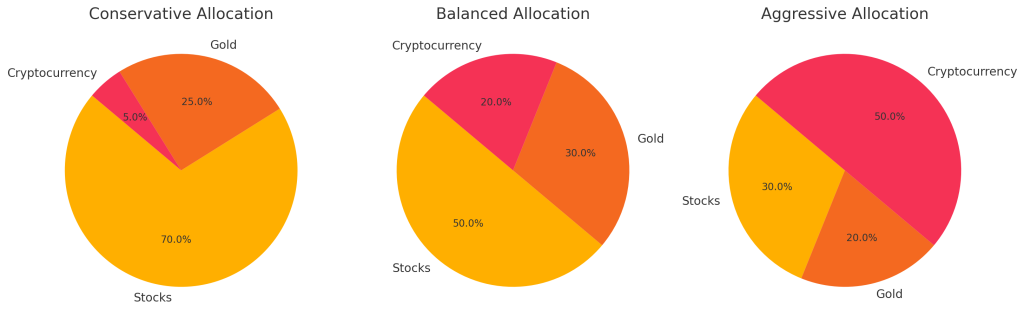
“Portfolio Allocation Strategies (Stocks, Gold, Crypto)”
This visual clearly compares conservative, balanced, and aggressive investor profiles using different mixes of stocks, gold, and crypto.
Final Thoughts: Building the Right Mix for a Complex Future
As we move deeper into 2025 and approach 2026, the global financial landscape is more unpredictable than ever. Inflation lingers, AI is reshaping the workforce, interest rate cycles are shifting, and digital assets are finally becoming institutionalized. Against this backdrop, the traditional 60/40 stock-bond portfolio no longer fits every investor’s needs.
A smarter allocation strategy includes three proven components:
- Growth exposure via equities
- Asymmetric upside via crypto
- Crisis protection via gold
By combining these, investors can hedge against multiple scenarios:
| Scenario | Crypto | Stocks | Gold |
| Rapid tech growth + Fed cuts | ✅ | ✅ | ⚠️ |
| Rate hike surprise + stagflation | ⚠️ | ❌ | ✅ |
| Geopolitical or banking crisis | ⚠️ | ❌ | ✅✅ |
| Continued soft landing | ✅ | ✅ | ✅ |
This isn’t just diversification — it’s functional hedging. Each asset plays a different role:
- Crypto is your high-volatility, high-reward engine.
- Stocks are your backbone for long-term capital appreciation.
- Gold is your insurance against the system itself.
Practical Tips for 2025–2026 Portfolio Allocation
Here are five actionable rules to follow:
- Stay flexible — macro conditions can change quickly.
- Avoid extremes — don’t go 100% into any one asset class.
- Use ETFs and DCA — simplify exposure and reduce timing risks.
- Review quarterly — rebalance as crypto or gold outperform.
- Protect downside — cash reserves and gold reduce panic selling.
Bottom Line
If you’re still building your portfolio or trying to reposition it for the next cycle, don’t fall for binary thinking. It’s not about crypto vs. stocks or gold vs. tech — it’s about balance, adaptability, and understanding the role each plays.
In 2025–2026, the smartest investors won’t bet everything on one winner — they’ll build portfolios that win across scenarios.
Choosing the Best Fit: Which Asset Should You Prioritize?
Now that we’ve examined the performance, volatility, and role of each asset class—let’s address the core question: Which is the best investment right now? The answer depends on your goals, time horizon, and risk tolerance. Here’s a breakdown of when each asset makes the most sense:
1. When to Choose Stocks (Equities)
If you’re focused on long-term growth, have a moderate-to-high risk appetite, and are comfortable with market fluctuations, then stocks remain a staple. They offer:
- Higher average annual returns than most other traditional investments
- Access to dividends, compounding growth, and sector diversification
- An established legal and regulatory framework (especially in U.S. or EU markets)
But in 2025–2026, stocks face serious headwinds from:
- Uncertain Federal Reserve policy and lingering inflation
- Possible stagflation or earnings compression
- Geopolitical tensions that could rattle global markets
Best stock strategy for 2025–2026: Favor quality over hype—blue chips, dividend aristocrats, and sectors like energy, defense, and cybersecurity.
2. When Gold Shines Brightest
If you’re focused on capital preservation, want protection against currency devaluation or systemic risk, or anticipate a major recession or market crash, then gold remains a smart anchor.
Gold’s role is not to generate explosive returns—it’s to:
- Preserve purchasing power over decades
- Hedge inflation, fiat instability, or sovereign debt risks
- Act as an insurance policy when everything else tanks
In times of uncertainty—especially when central banks pivot—gold tends to outperform.
Best gold strategy: Own physical gold or top-tier ETFs like GLD or IAU. Consider 10–25% allocation in diversified portfolios, especially if nearing retirement or anticipating volatility.
3. When to Bet on Crypto (Primarily Bitcoin and Ethereum)
If you’re a high-risk, high-reward investor—or believe in macro shifts away from fiat systems—crypto might still offer generational upside.
Reasons to include crypto in 2025–2026:
- Post-halving rallies could lift Bitcoin and Ethereum to new highs
- Increasing institutional adoption (ETFs, custody, regulation)
- Geopolitical instability may favor decentralized stores of value
But this comes with caveats:
- Regulatory crackdowns can derail momentum
- Sentiment and narratives drive short-term price swings
- It remains highly speculative, especially altcoins
Best crypto strategy: Focus on BTC and ETH. Allocate 5–10% max in most portfolios unless you are young, risk-tolerant, or deeply informed.
Portfolio Strategy for 2025–2026
Let’s recap how you might combine all three:
| Profile | Stocks | Gold | Crypto | Goal |
|---|---|---|---|---|
| Conservative | 70% | 25% | 5% | Preserve wealth, minimize loss |
| Balanced | 50% | 30% | 20% | Balanced growth + protection |
| Aggressive | 30% | 20% | 50% | High-risk, high-reward |
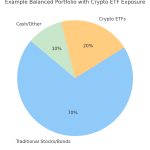
Portfolio pie chart to visualize these allocations.
Final Word: Don’t Think “Either-Or”—Think “Smart Mix”
In today’s world, binary thinking is dangerous. It’s not about crypto vs. stocks or gold. It’s about understanding how each complements the others in a complete investment strategy.
- Use stocks for growth.
- Use gold for stability.
- Use crypto for asymmetric upside.
In 2025–2026, the world is still adapting to a post-COVID, inflationary, fragmented global economy. Smart investors don’t pick favorites—they diversify intelligently, adjust often, and stay informed.