As the cryptocurrency market matures in 2025, investors are once again asking the age-old question: Should I invest in Bitcoin or Ethereum? These two titans of the crypto world dominate headlines, portfolios, and debates — yet their roles, risks, and rewards are increasingly different.
In this article, we’ll break down the current state of both cryptocurrencies, their use cases, price performance, and investment appeal — to help you decide which one fits your goals in 2025 and beyond.
Bitcoin in 2025: Digital Gold, Still King?
Bitcoin remains the world’s largest cryptocurrency by market cap — and its narrative as “digital gold” has never been stronger. In 2025, Bitcoin is not just a speculative asset. It’s being treated as a long-term hedge against inflation, fiat instability, and global debt cycles.
Institutions, governments, and retail investors continue to treat Bitcoin as a store of value — not a tool for decentralized apps or token creation.
Key characteristics of Bitcoin in 2025:
- Fixed supply: 21 million coins (with over 93% already mined)
- Inflation halved again in April 2024 (now just 3.125 BTC per block)
- Institutional adoption continues via ETFs and corporate treasuries
- Viewed as “macro safe haven” alongside gold — especially in volatile regions
Despite short-term volatility, many see Bitcoin’s long-term trajectory as bullish — even conservative forecasts often project $120,000–$160,000 by 2026, based on current on-chain metrics and macro trends.
Ethereum in 2025: Smart Contract Powerhouse
Ethereum, the second-largest cryptocurrency, plays a completely different role. It’s the foundational platform for decentralized finance (DeFi), NFTs, smart contracts, DAOs, and tokenized real-world assets. With the successful shift to proof-of-stake (completed in 2022) and multiple scaling improvements, Ethereum has positioned itself as the infrastructure layer for Web3.
In 2025, Ethereum powers:
- A growing universe of Layer 2s (e.g., Arbitrum, Optimism, Base)
- DeFi platforms like Aave, Uniswap, Curve
- Stablecoins like USDC, DAI, and institutional tokenization projects
- Real-world assets, like tokenized treasuries, debt instruments, and digital identity
It’s more than just a coin — it’s a technology platform. Ethereum’s value depends not only on adoption, but also on network activity, gas fees, and developer ecosystem strength.
Price Performance: Bitcoin vs. Ethereum (2020–2025)
When comparing investment returns, both Bitcoin and Ethereum have shown strong historical growth — but they’ve taken different paths.
Bitcoin has outperformed Ethereum during market downturns, demonstrating its reputation as the “safe haven” of crypto. It’s less volatile and draws more institutional support. However, Ethereum often outpaces Bitcoin during bull markets due to explosive growth in applications built on its network.
Here’s a simplified view of their approximate price performance over recent years:
| Year | Bitcoin (BTC) | Ethereum (ETH) |
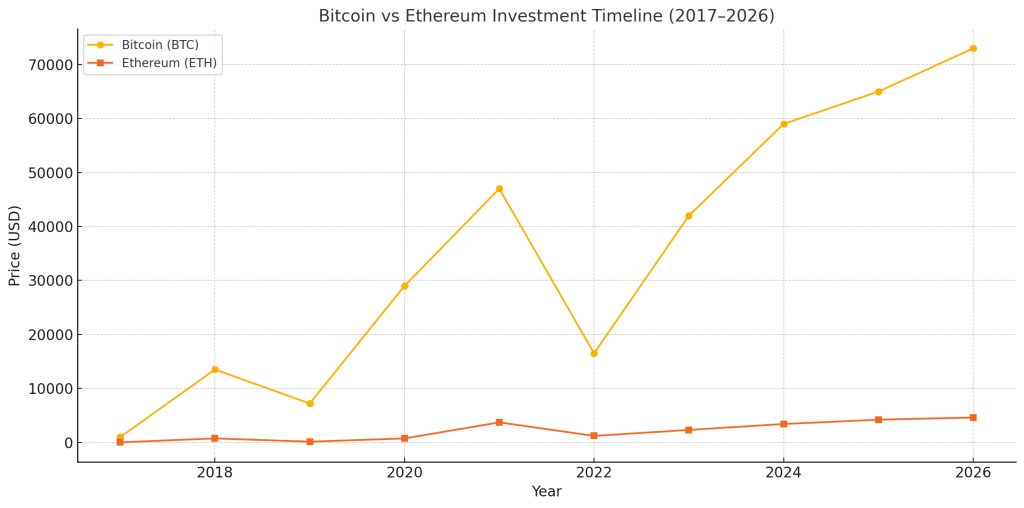
| 2020 | ~$7,200 → ~$29,000 | ~$130 → ~$750 |
| 2021 | ~$29,000 → ~$46,000 | ~$750 → ~$3,700 |
| 2022 | ~$46,000 → ~$16,500 | ~$3,700 → ~$1,200 |
| 2023 | ~$16,500 → ~$42,000 | ~$1,200 → ~$2,300 |
| 2024 | ~$42,000 → ~$69,000 (ATH), ~$59,000 now | ~$2,300 → ~$3,800 (ATH), ~$3,200 now |
| 2025* | ~$59,000 → ~$61,000 (mid-year est.) | ~$3,200 → ~$3,450 (mid-year est.) |
*Approximate average through July 2025 based on major exchanges
Observations:
- Ethereum gains more in bull markets but loses more in bear phases.
- Bitcoin holds better during macro stress or market crashes.
- Ethereum’s price is more closely tied to network usage and gas demand.
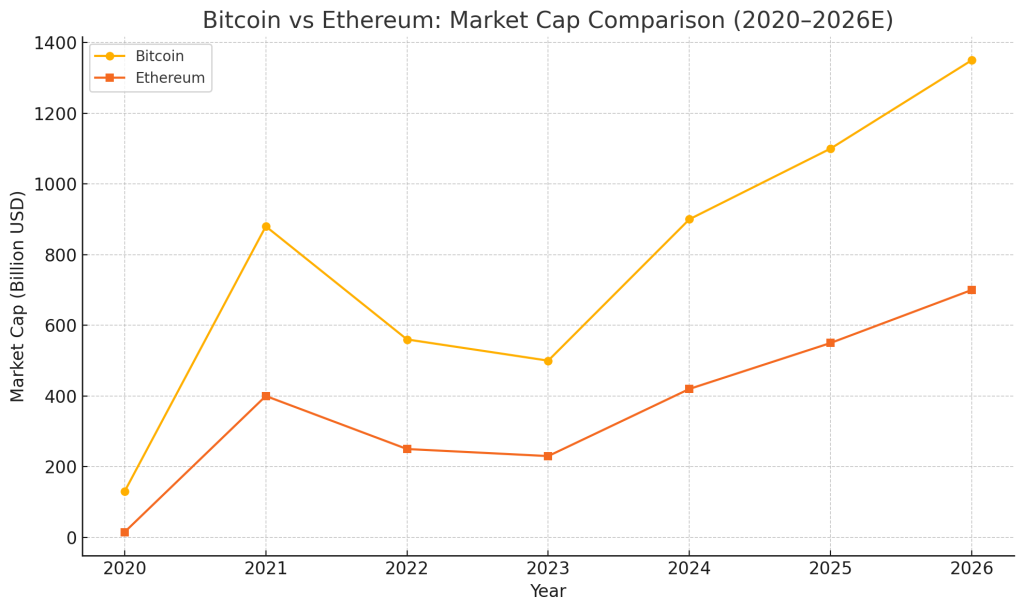
Here is the second chart: “Bitcoin vs Ethereum: Market Cap Comparison (2020–2026E)” — tracking estimated and historical market caps.
Different Investor Profiles
Bitcoin: For the Long-Term Macro Hedge
If you’re looking for a long-term hedge against global monetary debasement, Bitcoin is likely a better fit. It’s favored by:
- Institutional investors
- Conservative crypto adopters
- Gold-alternative buyers
- Countries facing fiat currency crises
Bitcoin is relatively simple: buy, hold, and wait. It’s not built for utility — it’s built to retain value across decades.
Ethereum: For the Risk-Tolerant Innovator
Ethereum is better suited for tech-forward, growth-focused investors who believe in the tokenization of finance and the Web3 future. It attracts:
- Developers and builders
- Venture-style crypto investors
- DeFi, NFT, and Web3 users
- Younger investors looking for upside
It’s not as “safe” as Bitcoin — but in the right environment, ETH can outperform BTC by 2–3× in cycles.
Here is the Bitcoin vs Ethereum Investment Timeline (2017–2026) chart, showing price trends over the past and projected years.
How to Allocate: Bitcoin vs. Ethereum Based on Risk Tolerance
Choosing between Bitcoin and Ethereum doesn’t have to be an all-or-nothing decision. In fact, many seasoned investors hold both, adjusting the ratio based on their risk appetite, investment horizon, and market outlook.
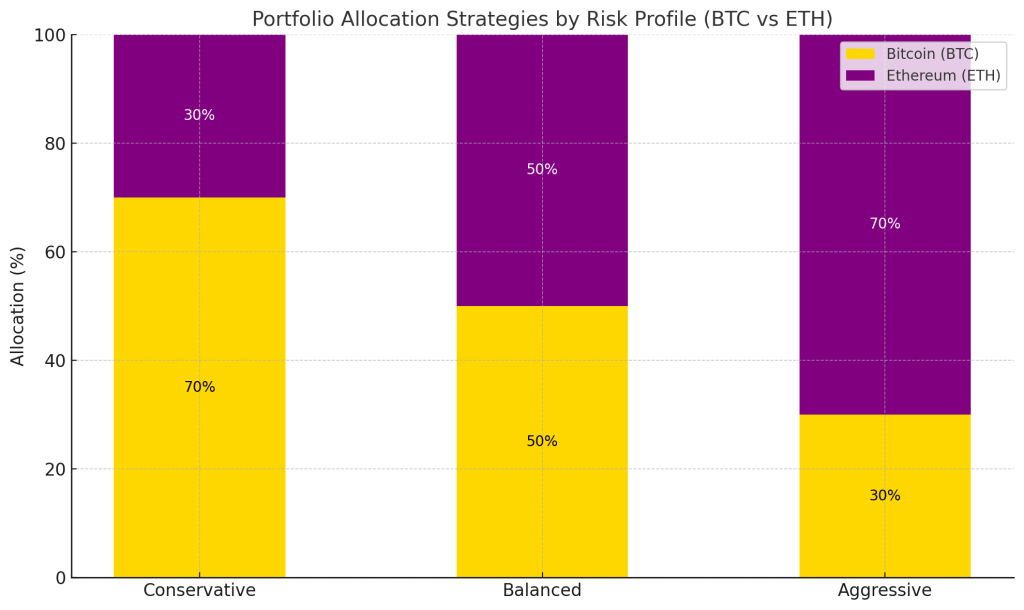
Here’s a simple framework for allocating between BTC and ETH:
🔹 Conservative Investor (Low Risk Tolerance)
Goal: Preserve capital, avoid volatility
Suggested Allocation:
- 80% Bitcoin
- 20% Ethereum
This allocation prioritizes Bitcoin’s stability and institutional backing. It assumes Ethereum will continue to grow, but limits exposure to its higher volatility and potential tech risks (e.g., smart contract exploits, scaling issues).
🔹 Balanced Investor (Moderate Risk Tolerance)
Goal: Balanced growth and resilience
Suggested Allocation:
- 60% Bitcoin
- 40% Ethereum
This mix allows for Ethereum’s upside during bull runs while still relying on Bitcoin as the macro anchor. It’s suitable for long-term holders who are bullish on both assets and don’t plan to sell in the next few years.
🔹 Aggressive Investor (High Risk Tolerance)
Goal: Maximize potential upside
Suggested Allocation:
- 40% Bitcoin
- 60% Ethereum
This allocation is common among crypto-native investors and those who strongly believe in the future of smart contracts, DeFi, and tokenized economies. While it has higher upside potential, it also exposes you more to regulatory shifts, technical risks, and scalability challenges.
Bitcoin/Ethereum portfolio allocation chart based on different risk profiles
Comparative Chart: Bitcoin vs. Ethereum Investment Profiles
| Feature | Bitcoin (BTC) | Ethereum (ETH) |
| Purpose | Store of value | Smart contract platform |
| Volatility | Lower | Higher |
| Network Adoption | Broad, macro-focused | Rapid, innovation-driven |
| Institutional Support | Strong | Growing |
| Regulatory Risk | Lower | Higher (due to utility tokens) |
| Inflation Schedule | Fixed (21 million max supply) | Mildly inflationary (post-merge) |
| Best For | Hedging, capital preservation | Growth, tech exposure |
Final Word: Which One Should You Own in 2025?
If you could only pick one, pick Bitcoin.
It’s still the safest bet, especially in a macro environment filled with inflation, geopolitical tension, and central bank uncertainty. It’s the gold of crypto.
But ignoring Ethereum entirely may leave gains on the table — especially in a bull market. Ethereum is evolving into the base layer of Web3, and ETH remains the fuel that powers that machine.
Smartest move?
Hold both. Tilt your portfolio based on your goals:
- If you fear a crash or recession → tilt toward Bitcoin
- If you believe in the tech revolution → tilt toward Ethereum
In 2025–2026, both assets are poised to grow — but through very different engines.
Here article on how Bitcoin’s potential to crash again.
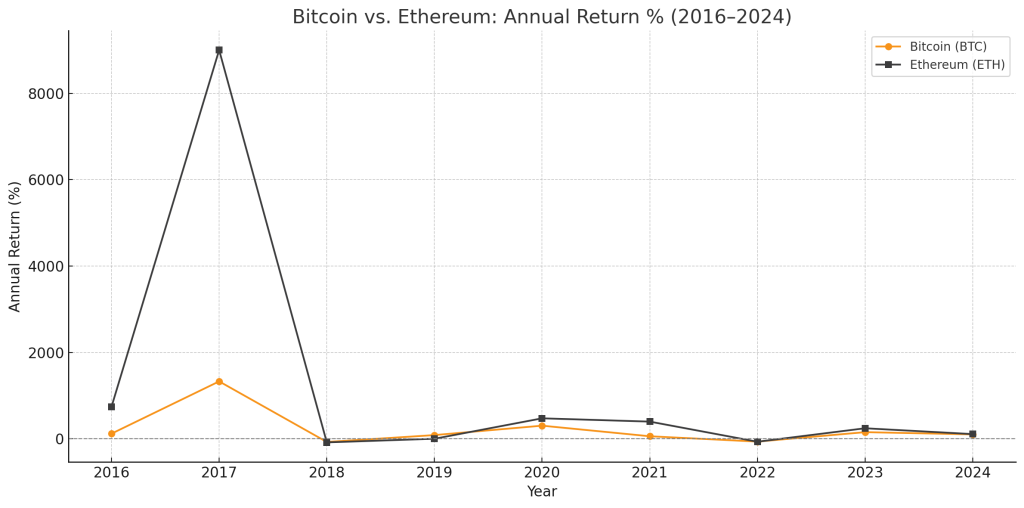
“Bitcoin vs. Ethereum: Annual Return % (2016–2024)
Institutional Sentiment and Investment Flow
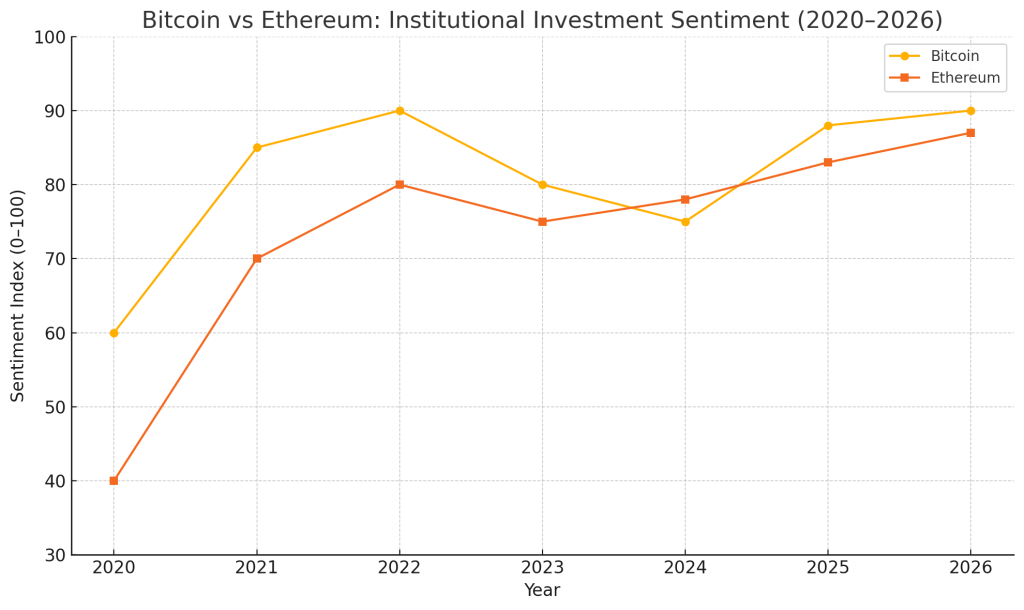
One of the most critical shifts in recent years has been the formal entrance of institutional investors into crypto. Bitcoin has long been the primary beneficiary of this trend, thanks to its simplicity, predictability, and acceptance as a non-sovereign store of value. In 2024–2025, with multiple spot Bitcoin ETFs launching in the U.S., investment giants like BlackRock, Fidelity, and ARK Invest began allocating substantial capital into Bitcoin vehicles along with real estate.
Ethereum, while also included in some broader crypto investment products, hasn’t captured the same scale of institutional inflow. Why? Because Ethereum’s investment thesis is more nuanced. It’s a utility-driven asset—more like investing in early-stage internet infrastructure than in digital gold. This complexity deters some traditional players who prefer clear, digestible narratives.
Still, Ethereum is gaining ground. The approval of futures-based Ethereum ETFs and growing corporate use of Ethereum-based applications (like JPMorgan’s Onyx or supply chain tracking platforms) indicate that sophisticated players are beginning to recognize its potential. If a spot Ethereum ETF is approved in late 2025 or 2026, it could be a game changer.
Here is the chart “Bitcoin vs Ethereum: Institutional Investment Sentiment (2020–2026)”, showing how investment sentiment has evolved over time.
Inflation, Recession, and Global Risk
Another macro factor shaping the 2025–2026 cycle is the interplay between inflation, central bank policy, and geopolitical tension. When inflation runs high or fiat currencies weaken, Bitcoin tends to benefit due to its fixed supply and perception as “digital gold.” This has been seen clearly in countries with currency crises—Turkey, Argentina, Nigeria—where grassroots Bitcoin adoption spikes.
In contrast, Ethereum’s correlation with macro events is more complicated. During risk-off environments, ETH has often behaved more like a tech stock than a hard money asset. This is because Ethereum is still seen by many investors as a bet on innovation, which can underperform during high-volatility, capital-conserving periods.
However, if markets shift toward renewed optimism—driven by falling interest rates, AI-fueled tech growth, or successful regulatory frameworks—Ethereum could significantly outperform. Its upside potential is more asymmetric than Bitcoin’s, but also more sensitive to downside shocks.
Use Case Dominance and Developer Momentum
Ethereum clearly leads in developer activity, decentralized app (dApp) ecosystems, and transaction volumes. According to Electric Capital’s 2025 Developer Report, Ethereum still has over 4× more monthly active developers than Bitcoin. Moreover, the bulk of new Layer 2 solutions, DeFi platforms, NFT marketplaces, and decentralized identity systems continue to launch on Ethereum or its rollups (like Arbitrum and Optimism).
This deep moat gives Ethereum a unique competitive advantage. Network effects matter, and Ethereum’s Layer 2 ecosystem may soon exceed the L1 in transactional volume. These scaling solutions allow Ethereum to maintain its decentralized integrity while supporting high throughput—a feature Bitcoin lacks natively.
That said, Bitcoin’s Taproot upgrade, the emergence of Ordinals (NFTs on Bitcoin), and sidechains like Rootstock are creating new momentum for Bitcoin’s utility beyond just being a store of value. Still, Ethereum’s lead in application infrastructure is significant and unlikely to be overturned quickly.
Security, Stability, and Network Risks
From a risk-adjusted investment perspective, Bitcoin wins on simplicity and stability. Its protocol is minimalistic, with fewer moving parts and a proven track record of surviving attacks, hard forks, and social controversy. Its proof-of-work consensus, though energy-intensive, is battle-tested.
Ethereum, after its 2022 shift to proof-of-stake (The Merge), reduced its energy usage by over 99%. While this transition has been praised for sustainability, it has also introduced new governance complexities and centralization concerns. The concentration of staking among a few entities (like Lido or Coinbase) could pose long-term security and censorship risks.
Moreover, Ethereum’s aggressive roadmap (Proto-Danksharding, EIP-4844, Verkle Trees) shows great ambition—but also introduces technical risk. Investors seeking lower volatility may prefer Bitcoin’s conservatism.
Regulatory Pressure and Global Adoption
Bitcoin benefits from global regulatory clarity. It is increasingly being recognized as a commodity (especially in the U.S.), which makes it easier to integrate into institutional portfolios. Ethereum’s legal classification, however, remains a moving target. The SEC’s past statements have been mixed—sometimes hinting that ETH might be a security, depending on its staking model and how it’s sold. USA Federal Reserve established Bitcoin strategic reserve.
If Ethereum faces tighter regulation (e.g., restrictions on staking-as-a-service, or limitations on DAOs), it could temporarily lose favor among mainstream investors. However, this also presents an opportunity for Ethereum to work with regulators and establish itself as the compliant base layer for web3 innovation.
In terms of global adoption, Bitcoin remains the gateway coin in emerging markets. But Ethereum’s dominance in areas like remittances, digital ID, and microfinance is growing, particularly in countries like the Philippines, Kenya, and Brazil.
Conclusion: Bitcoin or Ethereum in 2025–2026?
The answer depends on your investment profile and macro expectations.
- If you seek preservation of capital, inflation hedging, and global liquidity, Bitcoin remains king. It’s the more conservative, battle-tested asset with growing institutional infrastructure and proven resilience.
- If you aim for higher risk-adjusted returns, exposure to emerging technologies, and belief in the programmable future of finance, Ethereum offers more upside—albeit with more complexity and regulatory uncertainty.
In reality, the smartest approach may be both. The two assets complement each other in a diversified crypto portfolio—much like stocks and bonds in traditional investing. You may want to read our article comparing Bitcoin vs stocks as assets.