For years, Bitcoin bulls have pointed to lofty six-figure targets—$250,000, $500,000, even $1 million per coin. But now, in mid-2025, with Bitcoin stabilizing above $100,000 and institutional inflows cooling, a growing number of investors are asking a more practical question:
What is the realistic peak for Bitcoin in this cycle?
After reviewing historical trends, macro signals, and expert forecasts, one range emerges with surprising consensus: $140,000 to $160,000 by the end of 2026. This article explains why.
A Reality Check: Bitcoin’s Current Position
As of July 2025:
- Bitcoin price: ~$108,000
- ETF inflows: Strong but slowing, now ~$4.7B/month
- Inflation (U.S.): ~3.8%
- Fed interest rate: 4.25% (with rate cuts likely in Q4)
- Post-halving timeframe: ~15 months since April 2024 halving
These metrics point to a healthy market, but not a runaway bubble. The fundamentals remain strong—but restrained.
What the Experts Are Actually Predicting
Despite attention-grabbing headlines calling for $250K and beyond, most serious crypto analysts and data platforms are more conservative. Here’s what they say:
| Source | 2026 Forecast | Notes |
| Changelly | $163,582 | Base model using historical cycles + ETF inflows |
| CoinDCX | $95K–$135K | Depends on macro stability |
| InvestingHaven | $99,910 – $200K | Wide range; top end assumes retail mania returns |
| Capital.com | ~$163K | Based on halving model and liquidity projections |
📌 Median forecast: between $140K and $160K — a healthy, attainable range that doesn’t require a moonshot.
Why This Range Makes Sense in 2026
1. Halving History Points to a Controlled Climb
Let’s look at past post-halving performance:
| Halving Year | Price at Halving | Peak Price | Months to Peak |
| 2012 | $12 | ~$1,150 | 12 |
| 2016 | $650 | ~$20,000 | 17 |
| 2020 | $8,600 | ~$69,000 | 18 |
| 2024 | $34,000 | ??? | ??? |
If this cycle follows history, we can expect the next peak to arrive between late 2025 and early 2026, likely in the $130K–$160K range based on average cycle multiples (4x–5x from halving price).
2. ETF Inflows Support—but Don’t Explode—Valuation
U.S. spot Bitcoin ETFs have brought legitimacy and liquidity to Bitcoin, with over $4.7 billion flowing in monthly at peak. But inflows have leveled off in mid-2025. Unless a second institutional wave begins (pension funds, sovereign wealth), prices may rise steadily—but not explosively.
According to Bitwise, total inflows could reach $420B by end of 2026—a huge number, but spread over time and already partially priced in.
3. Macro Environment Not Fully Supportive
While inflation is cooling and rate cuts may begin in late 2025, we are not yet in a 2020-style stimulus cycle. Liquidity conditions are improving—but cautiously. This environment supports gradual growth, not mania.
Other factors like global sovereign debt (U.S., Japan), geopolitical friction, and stagnant wage growth continue to weigh on high-risk assets.
Bitcoin’s Place vs. Gold and Stocks in 2025–2026
Bitcoin is increasingly discussed as a competitor to gold and a hedge against inflation—but it’s not a direct replacement. Here’s how it stacks up:
| Asset | 2025 Status | Investment Role |
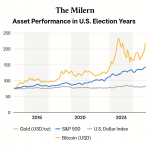
| Gold | ~$3,400 (ATH) | Inflation hedge, stable, low upside |
| Stocks | Dow ~flat, Nvidia strong | Earnings-sensitive, cyclical |
| Bitcoin | ~$108,000 | Volatile, asymmetric, limited supply |
Conclusion: Bitcoin can outperform both—but only with modest macro tailwinds. $140K–$160K is a powerful outcome without requiring a global crisis or mania.
What Could Change This Outlook?
Here’s what could push Bitcoin above $160K:
- A sudden return to QE (quantitative easing) or Fed balance sheet expansion
- A major banking crisis (think: Wells Fargo, Bank of America contagion)
- Mass retail mania like 2021 (TikTok traders, corporate purchases)
- High-profile adoption (e.g., Apple, Google, or PayPal adding BTC to balance sheet or payments)
Without those, a realistic ceiling stays under $170K.
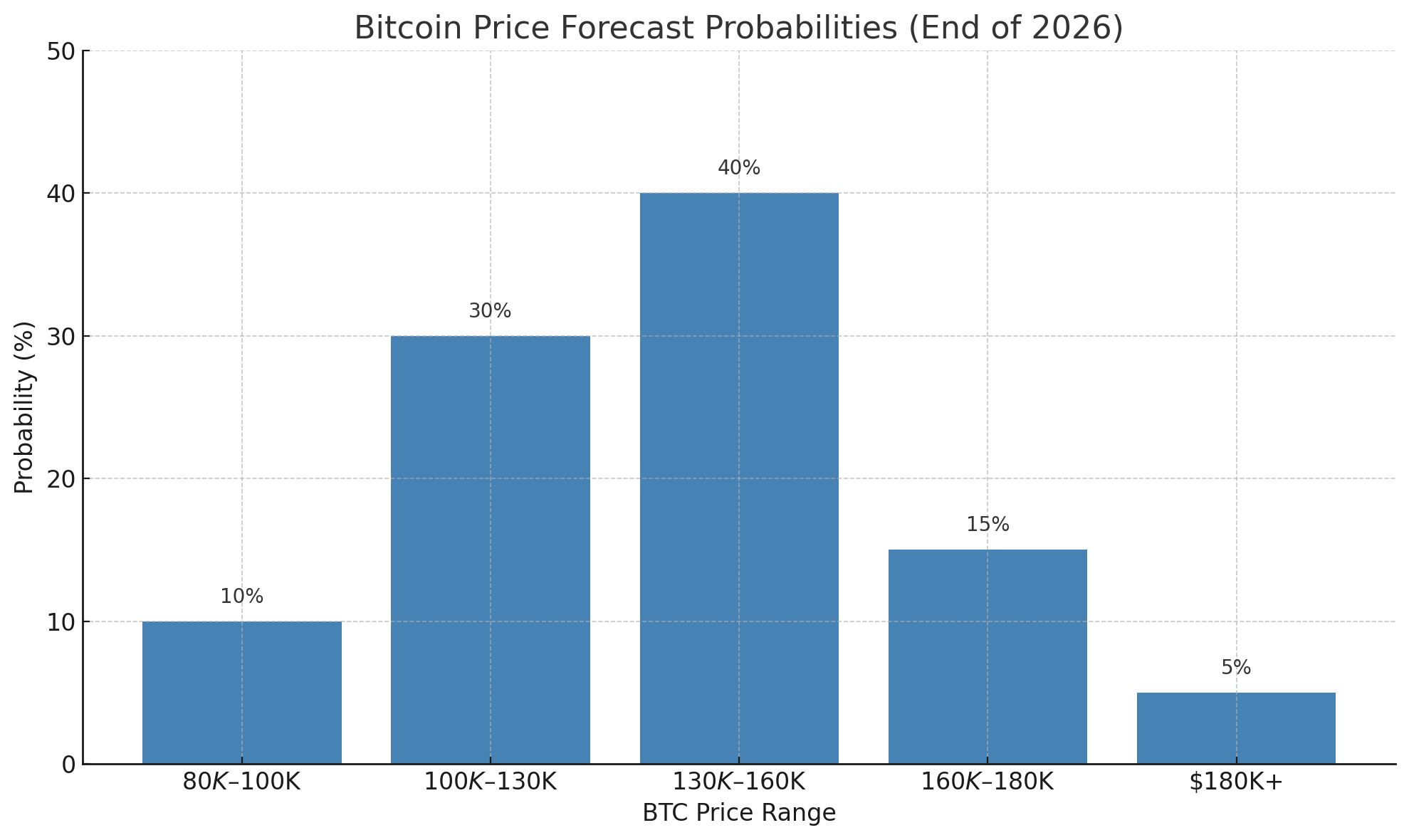
Forecast Chart: BTC Price Probability in 2026
| Price Level | Likelihood |
| $80K–$100K | 10% |
| $100K–$130K | 30% |
| $130K–$160K | 40% |
| $160K–$180K | 15% |
| $180K+ | 5% |
A well-constructed portfolio should be positioned for the mid zone, with optional exposure to upside.
Strategy: How to Position for the $140K–$160K Case
- Core Hold: Keep a long-term BTC stack with no plans to sell below $140K
- Tactical Scaling Out: Consider taking partial profits at $130K, $145K, and $160K
- Hedge with Gold or Cash: In case of macro reversal, these assets can stabilize your portfolio
- Stay Alert: If ETF inflows surge again or the Fed surprises, reassess the $200K scenario
Intermediate Thoughts
Bitcoin doesn’t need to hit $250,000 to be a success story. If it climbs to $140,000–$160,000 by 2026, that represents a 300%+ gain from the 2024 halving, and a strong outperformance against almost every other asset.
Rather than dreaming of extreme outcomes, smart investors should focus on what’s probable—not just possible. The $140K–$160K case isn’t just conservative. It may be the most likely — and most profitable — move of this cycle.
Why Bitcoin’s Growth May Slow Compared to Previous Cycles
One key reason the $140K–$160K ceiling is more realistic than previous moonshot targets lies in Bitcoin’s maturing market structure.
In early cycles (2012–2017), a relatively small amount of new capital could dramatically move the price. But today, Bitcoin is a trillion-dollar asset, and new gains require massive, sustained inflows.
Diminishing Return Effect
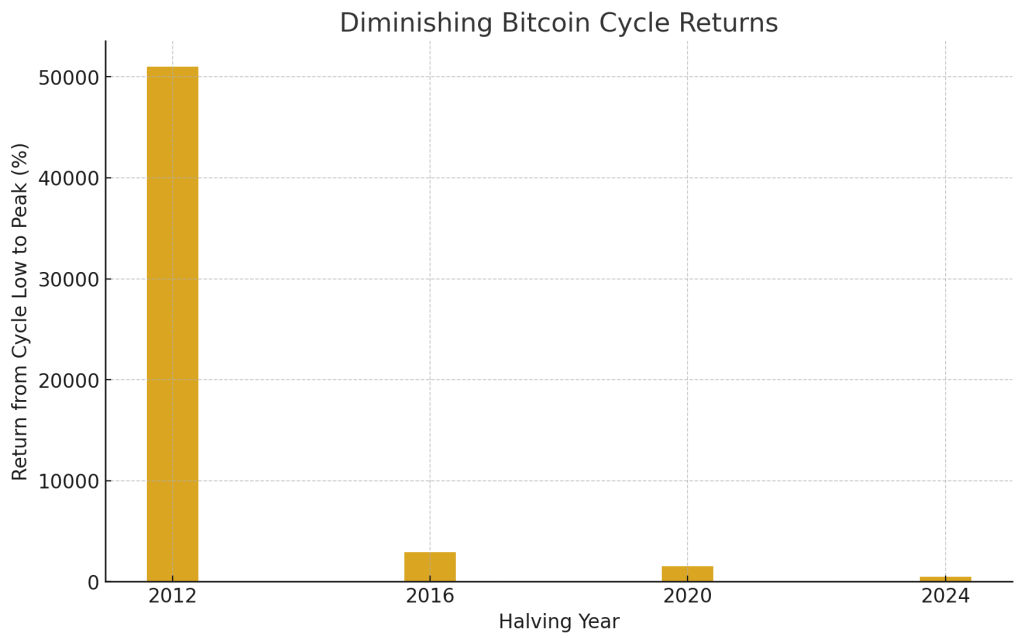
Each halving has produced lower percentage returns from cycle low to cycle peak:
| Halving Year | Cycle Low → Peak % Return |
| 2012 | ~51,000% |
| 2016 | ~2,900% |
| 2020 | ~1,500% |
| 2024 | TBD |
If this trend holds, a 500–600% return from the 2022–2023 bear market low (~$15,500) would place Bitcoin’s peak in this cycle around $90K–$120K, possibly stretching to $150K with a strong tailwind.
The diminishing returns model doesn’t suggest failure — only that Bitcoin’s price is stabilizing as it matures into a global asset class. It trades more like digital gold and less like a startup.
Diminishing Bitcoin Cycle Returns – showing how the percent return from each cycle’s low to peak has declined, supporting a more moderate $140K–$160K expectation.
Institutional Money Still Cautious, Not All-In
Despite ETF approvals in 2024 and strong inflows in early 2025, the pace has moderated. Most major institutions have dipped their toes, not fully embraced Bitcoin.
Key observations:
- Pension funds remain underexposed due to volatility and regulatory risk.
- Endowments prefer Ethereum-based “Web3” investments over BTC.
- Banks like JPMorgan and Wells Fargo offer access, not endorsement.
- Retail brokerages (Robinhood, Fidelity) offer BTC—but few promote it as a core holding.
This shows growing acceptance, not full adoption. To see explosive price movement, Bitcoin would need:
- A wave of public pension plans allocating even 1%
- Central banks or sovereign funds announcing BTC purchases
- Financial advisors moving clients from gold to Bitcoin en masse
Without these shifts, Bitcoin’s next leg higher will likely be strong but contained — again reinforcing the $140K–$160K range.
Regulatory Climate: Progress, Not Clarity
Another reason to temper expectations is the regulatory fog still surrounding crypto.
In the U.S., the SEC has softened its stance on Bitcoin but remains hostile toward:
- DeFi platforms
- Self-custody infrastructure
- Privacy coins
- Stablecoin issuers
While Bitcoin enjoys more legal clarity than most cryptos, it still faces headline risks, especially if a new administration (in the U.S. or EU) cracks down further.
For example:
- An SEC reversal on ETF expansion
- Tighter capital gains enforcement
- European restrictions on energy-intensive mining
- Limits on transferring BTC to cold wallets
Any of these could spook markets short term and delay progress toward $160K+.
Global Signals Suggest BTC’s Role Is Expanding—But Gradually
Beyond the U.S., other parts of the world are adopting Bitcoin—but not explosively. For instance:
- Nigeria, Argentina, and Turkey continue to lead in P2P BTC transactions, driven by currency instability
- El Salvador remains a unique experiment, but hasn’t sparked broader sovereign adoption
- Dubai and Singapore lead in crypto-forward regulation, but BTC isn’t yet used as money
Bitcoin is winning as a strategic reserve asset, not yet as a replacement for fiat. This long-term role supports higher valuations over time, but not necessarily dramatic price spikes within 12–18 months.
Gold’s Rise Is a Clue: Bitcoin Is Becoming a Macro Asset
One of the most telling signals in 2025 is that gold has surged to over $3,400, despite a lack of global panic. Investors are clearly looking for safe havens outside fiat currencies—but aren’t yet fleeing into Bitcoin at the same scale.
This supports the idea that Bitcoin is on the path to “digital gold” status, but hasn’t fully arrived. For it to reach parity with gold (at least in perception), it would need:
- Broader adoption as a reserve asset
- More predictable legal protections
- Lower volatility and clearer custody standards
These developments are in progress, and a $140K–$160K Bitcoin in 2026 would reflect that middle ground: no longer just a speculative asset, not yet a full store of value.
Sentiment and Speculation: The Missing Mania
In past bull markets, Bitcoin’s final surge was always driven by a massive emotional wave:
- 2013: “Bitcoin is going to $1,000 — forever!”
- 2017: “Crypto will replace the dollar!”
- 2021: “Laser eyes to $100K!” + meme stocks + Dogecoin
But in 2025, even as Bitcoin reclaims $100K, sentiment remains cautious:
- Google Trends show BTC search volume far below 2021
- Social media influencers now focus more on AI than crypto
- Younger investors are experimenting with tokenized real estate, not just BTC
Without full retail mania, Bitcoin may still climb — but it won’t explode. This supports a structured, mature market rally that ends not with a bang, but with a high plateau.
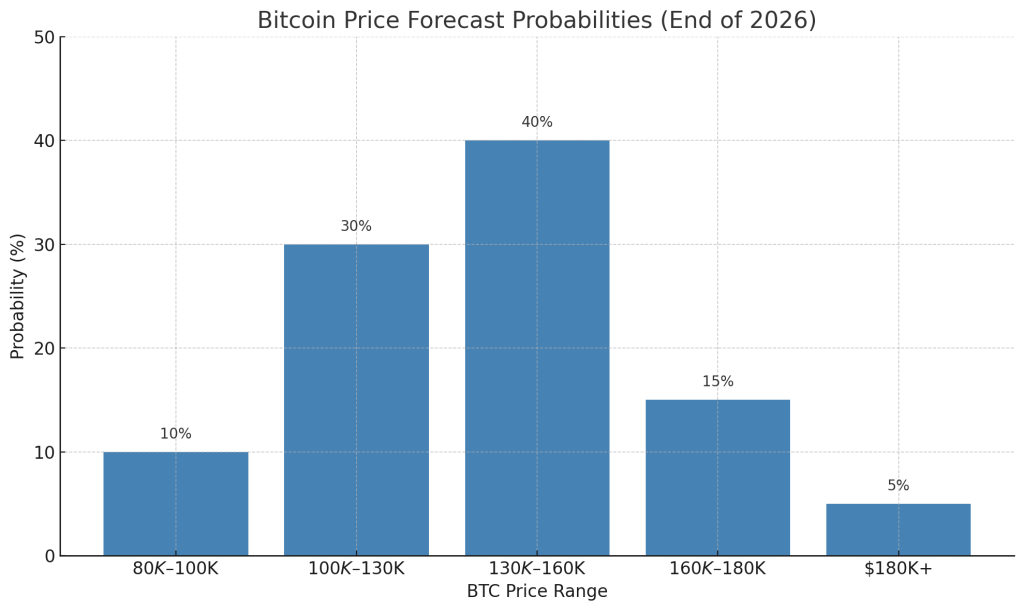
Bitcoin Price Forecast Probabilities (End of 2026) – visualizing the projected likelihood of BTC reaching various price ranges, with $130K–$160K as the most probable.
Could the Election Cycle Impact Bitcoin?
Yes. The 2024 U.S. presidential election brought some regulatory uncertainty, but now that the dust has settled, Bitcoin’s policy direction will be influenced by:
- Who controls the SEC and CFTC
- Whether Congress passes comprehensive crypto rules
- Global reactions from EU, Japan, and South Korea
If the U.S. remains crypto-neutral into 2026, expect steady growth. But if the regulatory tone turns aggressively positive (e.g., legal protections for self-custody), the upside could surprise to the $180K+ side.
Still, these are conditional variables. A conservative outlook should anchor to what we know today—not future hypotheticals.
Lessons from Ethereum: Tech ≠ Price
Ethereum has seen major technical upgrades in 2024–2025—faster transactions, lower fees, new staking protocols. And yet, its price has lagged behind Bitcoin and remains under $5,000.
This shows a broader trend: crypto prices no longer move purely on technology or vision. They move on:
- Capital flows
- Regulation
- Risk appetite
- Economic conditions
Bitcoin’s fundamentals are strong—but they don’t guarantee a parabolic outcome. They justify a healthy, stable valuation increase toward $150K, not a moon run.
Summary: This Cycle’s Realistic Outcome
Let’s zoom out.
- The $140K–$160K range is supported by historical data, halving multiples, institutional behavior, and current macro trends.
- A blow-off top to $250K is possible, but requires events we haven’t seen yet: mania, mass retail, or a liquidity crisis.
- Bitcoin is behaving more like a strategic macro asset—slow, strong, and steady.
That’s not boring. It’s progress.
Actionable Takeaways for Investors
- Expect strength, not insanity
Price appreciation will be real—but not exponential without a new catalyst. - Use a target ladder
Sell 20% at $130K, another 30% at $145K, and the rest between $155K–$160K if reached. - Keep exposure via ETF or custody
Long-term conviction matters, but so does liquidity. Choose vehicles wisely. - Don’t chase a myth
$250K may happen someday—but this cycle, realistic wins will outperform the dreamers.
More Specific Technical Data:
- Psychological vs. Technical Levels
Bitcoin now sits just below the $109k resistance zone — a key pivot area. Analyst Ed Campbell notes that a breakout above the $114k–$115k region could propel BTC over 25% higher toward ~$143,000 businessinsider.com. That signals the current rally isn’t just hype — momentum is building. - Institutional Inflows Confirm Strength
U.S. spot Bitcoin ETFs have seen consistent inflows — about $4.7 billion over 15 straight days, driven largely by BlackRock’s IBIT. On July 3 alone, net inflows totaled ~$602 million, including strong participation from Fidelity ainvest.com+14tradingnews.com+14theaustralian.com.au+14. This institutional capital is helping underpin BTC’s higher valuation. - Macro Outlook Supports Next Legs
Global X forecasts a potential move to $200k within a year (from ~$109k), citing ETF inflows, institutional adoption, and inflation hedge demand ainvest.comtheaustralian.com.au+1youtube.com+1. Meanwhile, Robert Kiyosaki called BTC “priceless” at $107k — a sentiment echoing investor belief in Bitcoin as long-term store of value u.today+7alphanode.global+7economictimes.indiatimes.com+7. - Upcoming Resistance: $114k–$115k
The record monthly close near $107k–$108k sets the stage for a July test at ~$115k. Analysts expect this to be the next breakout zone — a move above it may be key to resetting the entire cycle cointribune.com+6financemagnates.com+6businessinsider.com+6.