Bitcoin’s explosive rallies often end in dramatic crashes — wiping out billions of dollars in hours and catching even experienced investors off guard. But while crashes may feel “sudden,” they rarely come without warning.
If you know what to look for, the next Bitcoin collapse may not be a surprise at all.
In this article, we’ll break down:
- The five most common warning signs that a Bitcoin crash may be imminent
- What history tells us about how crashes form
- How to protect your capital before it’s too late
- And why even a crash can offer opportunity — if you’re prepared
Why Bitcoin Crashes Happen
Bitcoin is still a relatively young asset class, and its price is driven by a volatile mix of:
- Speculation and emotion
- Liquidity cycles
- Institutional flows
- Macroeconomic shocks
- Regulatory uncertainty
Unlike traditional markets, Bitcoin doesn’t have “circuit breakers” or centralized institutions backing its value. As a result, when selling starts, it can cascade rapidly, creating huge swings in hours or even minutes.
But there are patterns. Crashes rarely come out of nowhere — they build up through signs of instability.
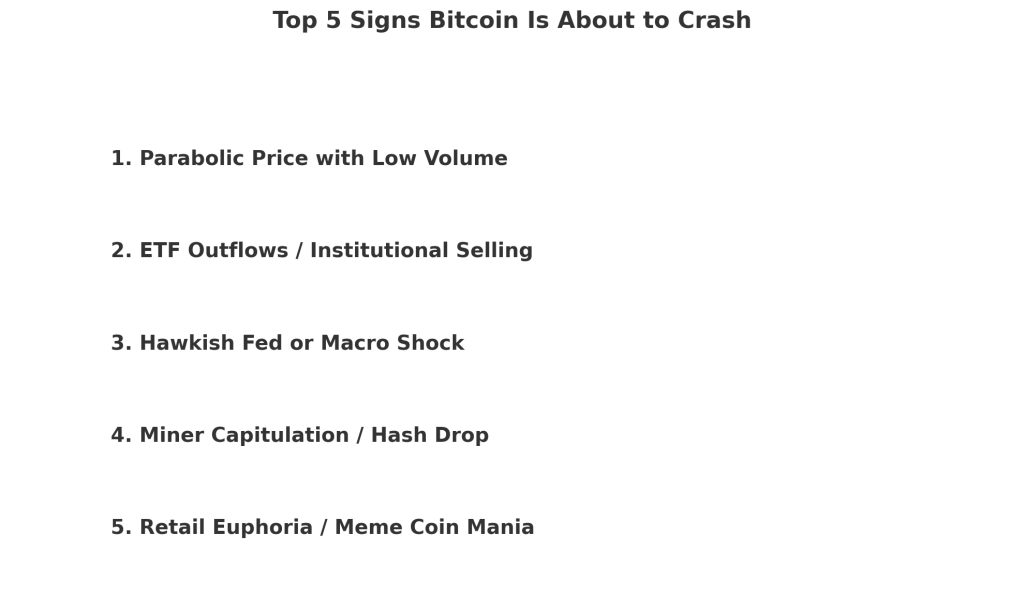
Sign #1: Parabolic Price Action Without Volume Support
If Bitcoin starts rising 10%+ per day for multiple days in a row — especially without matching trading volume — it’s often a sign of unsustainable momentum.
Historically, these vertical climbs precede major corrections. The classic pattern looks like this:
- Bitcoin moves gradually for months
- Suddenly, price accelerates sharply (often toward a round number like $100K)
- Retail FOMO kicks in, pushing price even faster
- Volume begins to thin, but price keeps rising — a warning sign
- A small sell-off triggers mass panic, and the crash begins
Example: April 2021
- BTC soared from ~$60K to ~$65K rapidly
- Trading volume dropped — while price hit ATHs
- Within weeks, it fell below $30K
How to prepare:
Watch daily volume on major exchanges (Coinbase, Binance). If volume stalls while price rises, consider trimming profits or setting trailing stop-losses.
Sign #2: Institutional Outflows or ETF Pullbacks
In the 2020s, institutional capital has become the backbone of Bitcoin’s price support. With ETFs, family offices, and hedge funds now holding sizable BTC positions, major outflows can signal trouble ahead.
ETF data is public — if we see:
- Several days of net outflows from leading ETFs (BlackRock IBIT, Fidelity FBTC, etc.)
- Declining open interest on CME Bitcoin Futures
- Whales moving coins to exchanges (via on-chain analytics)
…it often precedes a liquidity crunch.
Why this matters:
Institutions are now market makers in crypto. When they sell, volatility increases. When they exit, crashes follow.
How to prepare:
Track ETF flow reports (daily on sites like Coinglass, SoSoValue). If inflows slow or reverse during a price peak, tighten risk controls immediately.
Would you like me to continue with:
- Sign #3: Hawkish Fed Surprise or Macro Shock
- Sign #4: Miner Capitulation and Rising Hash Stress
- Sign #5: Explosive Retail Euphoria (Google Trends, Memecoins, TikTok)
- Then wrap up with Crash-Proofing Strategies + Summary
Sign #3: Hawkish Fed Surprise or Macro Shock
Bitcoin thrives on liquidity — and dies when it’s pulled.
If the U.S. Federal Reserve or European Central Bank unexpectedly announces:
- A rate hike instead of a cut
- Delayed or cancelled easing
- A shift to quantitative tightening (QT)
…the result is often an immediate sell-off in high-risk assets — and Bitcoin is at the front of the line.
Real-World Example: December 2021 – Early 2022
- Bitcoin traded near $69K in November 2021
- The Fed shifted tone in December, warning of multiple rate hikes
- BTC dropped over 50% in just three months
Even if economic data looks healthy, a hawkish pivot can instantly kill momentum. Bitcoin’s correlation to the Nasdaq and risk indices is still significant.
How to prepare:
Watch for Federal Reserve minutes, CPI releases, and major central bank speeches. If sentiment flips hawkish, move a portion of your capital into cash or defensive assets.
Sign #4: Miner Capitulation or Hash Rate Collapse
Bitcoin’s security depends on miners. When mining becomes unprofitable — due to rising difficulty, low prices, or high electricity costs — miners may start dumping BTC to stay afloat.
This is called miner capitulation, and it’s often a leading indicator of deeper pain.
Signs of miner stress:
- Hash rate drops significantly
- BTC mining revenue falls below breakeven
- Large mining wallets send coins to exchanges
- Mining stocks (like MARA, RIOT) underperform BTC sharply
Why it matters:
Miners are some of the largest holders of freshly minted BTC. When they sell, it adds downward pressure — especially in thin markets.
How to prepare:
Monitor hash rate trends (via Glassnode, Hashrate Index). If the network suddenly weakens, or miner wallets become active, it’s time to tighten risk.
Sign #5: Explosive Retail Euphoria (The TikTok Effect)
Ironically, the final stage of a bull market often feels the most exciting.
Retail investors rush in. Memecoins explode. TikTok creators shout price targets. Google searches for “how to buy Bitcoin” spike overnight.
This is a red flag — not a green light.
Look for:
- Surge in Google Trends for “Bitcoin” or “crypto”
- Influencers promoting get-rich-quick coins
- Altcoins with no use case pumping 10x
- Exchanges reporting record new signups
- Meme cycles repeating (e.g., Dogecoin, PepeCoin revival)
Why it’s dangerous:
This phase often brings in naive money at the top, giving smart money the liquidity they need to exit. It’s how 2021 ended — with NFTs, celebrity tokens, and Elon tweets.
How to prepare:
Use hype indicators as exit signals. When the average person suddenly becomes a crypto expert — it’s time to rebalance.
Bonus Signal: BTC Hits a Major Round Number… Then Stalls
Round numbers like $100K, $120K, and $150K serve as powerful psychological levels. If Bitcoin hits one, but can’t break through despite strong news or momentum, it often signals exhaustion.
This creates a “blow-off top” — where price briefly peaks, then rapidly reverses.
Protective Tip: If BTC wicks above a major level (say, $100K) but closes weak, consider setting trailing stop-losses or taking partial profits.
How to Prepare for the Next Crash
Crashes are inevitable — but they don’t have to be devastating. Here’s how to protect yourself without exiting the market completely.
1. Take Partial Profits on Strength
Don’t try to time the top perfectly. Sell in stages: 10–25% allocations at psychological levels like $120K, $140K, or $160K.
2. Use Trailing Stop-Losses
These follow the price up, locking in gains while keeping upside open. Ideal for volatile breakouts.
3. Diversify into Uncorrelated Assets
Even if you’re bullish, holding some gold, cash, or defensive stocks gives you protection against unexpected drawdowns.
4. Watch Volume and ETF Flow Daily
Price alone is not enough. Keep tabs on whether big money is entering or leaving the space.
5. Keep Emotion Out of It
Avoid the two most dangerous trading mistakes:
- Buying because everyone else is
- Selling in a panic when it’s too late
Having a plan beats having feelings.
Final Thoughts: Crashes Are Opportunities—If You’re Ready
Bitcoin’s history is filled with violent corrections:
- 2011: -93%
- 2014–15: -85%
- 2018: -84%
- 2022: -76%
But after every crash, the network grew stronger. The technology improved. The community rebuilt.
The winners aren’t the ones who never experience a crash — they’re the ones who expect it, plan for it, and use it as a launchpad for the next move.
Watch the signs. Stick to your strategy. And remember: the next crash doesn’t have to be your downfall — it could be your setup.
What Past Crashes Teach Us About the Next One
Understanding past Bitcoin crashes is critical to preparing for the next. While the triggers differ each time, the patterns and psychology often repeat.
Here’s a closer look at the most significant Bitcoin crashes:
| Year | Peak Price | Bottom Price | Drawdown | Time to Bottom | Trigger |
| 2011 | $32 | $2 | -93% | ~6 months | Mt. Gox hack, early hype |
| 2013–2015 | $1,150 | $170 | -85% | ~14 months | China ban, exchange collapse |
| 2017–2018 | $19,800 | $3,200 | -84% | ~12 months | ICO collapse, regulation |
| 2021–2022 | $69,000 | $15,500 | -77% | ~13 months | Fed tightening, Terra crash |
Key takeaway: Every crash was triggered by a combination of overheated speculation and a catalyst event (regulation, fraud, macro tightening).
That’s why being able to spot early signs of both is your best defense.
Advanced Crash Protection: What the Pros Do
Beyond simple diversification or stop-losses, experienced investors and traders use more advanced techniques to protect themselves before and during a crash:
1. Hedge with Inverse or Volatility Products
If you’re actively managing capital, you can use:
- Inverse Bitcoin ETFs (e.g., BITI) to profit from declines
- Options strategies (put options, collars) to limit downside
- Stablecoin rotations (e.g., USDC, DAI) to exit risky markets while staying in crypto infrastructure
These tools aren’t for everyone — but they’re how many institutional players survive crashes profitably.
2. Monitor On-Chain Metrics
On-chain analytics give real-time insights into market health:
- Exchange inflows: More BTC sent to exchanges = possible sell pressure
- Dormant supply activation: Old wallets moving coins = caution
- Funding rates: Over-leveraged long positions often precede liquidations
Sites like Glassnode, CryptoQuant, and LookIntoBitcoin offer free dashboards for these signals.
3. Hold Strategic Cash Reserves
If you hold zero cash during a bull market, you risk being forced to sell at the worst time. Holding 10–30% in stablecoins or fiat allows you to:
- Buy during dips
- Avoid panic selling
- Stay calm during volatility
Crashes are buying opportunities only if you have liquidity when others don’t.
Bitcoin Isn’t Dying — It’s Maturing
It’s tempting to fear a crash as an existential threat to Bitcoin. But every major dip in BTC’s history has preceded new highs and adoption milestones.
Here’s what came after each crash:
- Post-2011: Bitcoin passed $1,000 for the first time
- Post-2015: Ethereum launched, beginning a new crypto era
- Post-2018: Institutions entered via futures and custodians
- Post-2022: Spot ETFs launched, and BTC reached $100K
The current price volatility is part of a broader transition — from speculative asset to macro-relevant store of value.
The real question isn’t whether Bitcoin will survive the next crash. It’s whether you’ll be positioned to benefit from it.
Frequently Asked Questions (FAQs)
Q: Should I sell all my Bitcoin before a crash?
No. Timing the exact top is nearly impossible, and selling everything often leads to regret. Instead, scale out gradually, set trailing stops, and rebalance when momentum stalls.
Q: Is a Bitcoin crash different from a correction?
Yes. A correction is typically a 10–20% pullback in a healthy trend. A crash involves a sharp, sudden drop — usually 40% or more — often triggered by a macro or systemic event.
Q: How long do crashes usually last?
Most major Bitcoin crashes take 6–14 months to bottom out. But smaller drawdowns often reverse within 2–6 weeks, especially if the broader trend is bullish.
Q: Will ETF inflows prevent future crashes?
Not necessarily. ETFs add liquidity — but they also enable faster selling. Institutions aren’t emotionally attached to Bitcoin. If the macro environment shifts, they can exit faster than retail.
Final Words: Surviving the Downturn, Winning the Rebound
Crashes feel chaotic, but they are the natural rhythm of long-term growth. Bitcoin has crashed — and recovered — more times than most assets on Earth. It’s part of the deal.
What separates winners from losers is preparation.
If you watch the signs, build flexible strategies, and stay emotionally grounded, you won’t just survive the next crash.
You’ll be one of the few who’s ready to buy when everyone else is running.
That’s how real wealth is built in Bitcoin — not by chasing tops, but by owning bottoms.