Possibilities of a Flippening
Bitcoin (BTC) has long held the crown as the king of cryptocurrencies. As the original blockchain and the first successful digital money, it commands the highest market capitalization, strongest name recognition, and most institutional interest. But Ethereum (ETH), launched in 2015, has been steadily closing the gap—not just in valuation, but in real-world utility, development activity, and innovation.
This has given rise to the perennial question: Could Ethereum overtake Bitcoin by 2030?
The idea, often referred to as the “Flippening,” suggests that Ethereum might surpass Bitcoin in terms of market cap, usage, or cultural relevance. While it hasn’t happened yet, there are several compelling reasons why it could—alongside strong arguments for why Bitcoin may retain its dominance.
Let’s break it down.
1. Market Cap: The Core Metric of the Flippening
As of mid-2025, Bitcoin’s market cap sits near $2 trillion, with Ethereum at around $950 billion. While BTC still leads, ETH’s share has grown steadily, especially during periods of heavy DeFi and NFT activity.
Historically, Ethereum has outperformed Bitcoin in bull markets, owing to its more dynamic and diverse ecosystem. If this trend continues through 2026 and 2027, and if Ethereum successfully onboards new sectors like real-world assets, gaming, and AI protocols, it could eventually surpass Bitcoin’s market value.
That said, Bitcoin’s appeal as “digital gold” continues to attract long-term capital, including from sovereign wealth funds and retirement portfolios. Its simplicity may be its greatest strength.
2. Utility and Ecosystem: Ethereum Has More Going On
Ethereum is not just a currency—it’s a platform for decentralized applications (dApps), smart contracts, and entire financial systems. It powers:
- DeFi protocols like Aave and Uniswap
- NFT platforms like OpenSea
- DAO governance structures
- Layer 2 scalability solutions like Arbitrum, Optimism, and Base
- Real-world asset tokenization (RWAs)
In contrast, Bitcoin’s use cases remain narrower: store of value, payment rail, and occasionally collateral in DeFi.
If the future of crypto is about enabling programmable money, digital identity, and decentralized economies, Ethereum is far better positioned than Bitcoin. Its developer activity, GitHub commits, and network fees all support this narrative.
3. Transition to Proof-of-Stake: Green and Scalable
Ethereum’s switch to Proof-of-Stake (PoS) in 2022 was a game-changer. The Merge drastically reduced energy consumption (by over 99%), enabling Ethereum to shed the “dirty crypto” label and appeal more to ESG-conscious investors.
Meanwhile, Bitcoin remains firmly PoW (Proof-of-Work), consuming massive amounts of energy. While PoW advocates argue this provides superior security and decentralization, it’s also a frequent target of environmental criticism and regulatory scrutiny.
PoS has also enabled Ethereum’s staking economy, which rewards holders while securing the network—a significant incentive for long-term investors.
4. Institutional Adoption: Bitcoin Still Has the Edge—For Now
Despite Ethereum’s technical advantages, Bitcoin remains the institutional favorite. It’s simple, scarce (capped at 21 million coins), and seen as the most “regulation-proof” asset in crypto. Spot Bitcoin ETFs were approved first, and more traditional asset managers hold BTC than ETH.
However, this could shift. Ethereum ETFs are on the horizon, and the appeal of ETH as a yield-generating asset through staking may soon attract new institutional players looking for “crypto alpha” beyond just holding Bitcoin.
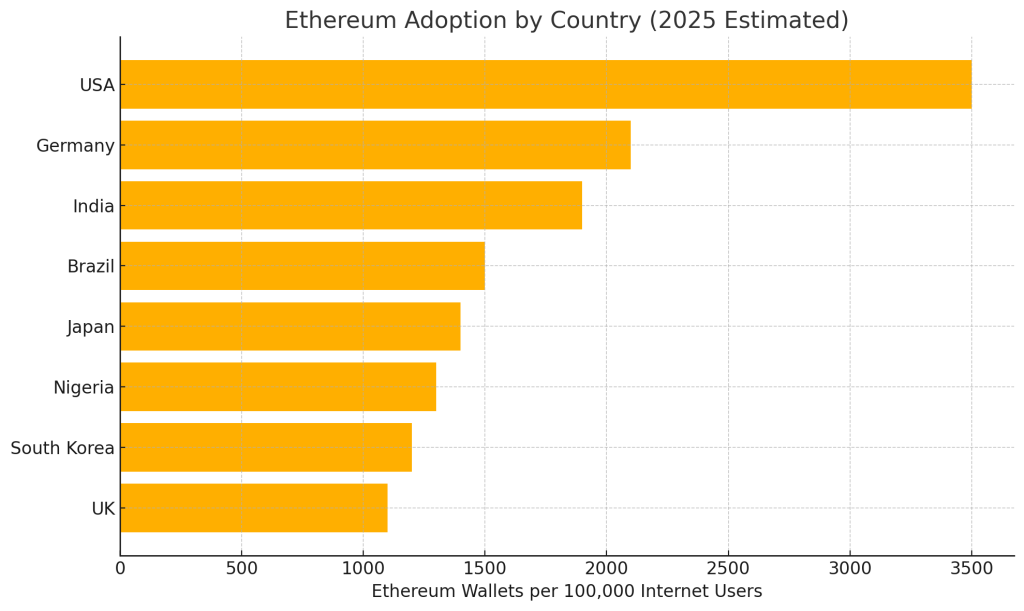
Here’s the chart showing estimated Ethereum adoption by country in 2025, measured as the number of Ethereum wallet addresses per 100,000 internet users.
5. Innovation and Development: Ethereum Leads in Activity
One of Ethereum’s greatest strengths lies in its developer community. It consistently ranks as the most actively developed blockchain, with thousands of developers working on core protocol upgrades, dApps, layer 2 solutions, and experimental technologies.
Major Ethereum developments like:
- The Merge (2022 – transition to PoS),
- The Surge (scaling via rollups),
- The Scourge (MEV resistance and censorship protection),
- The Verge (verkle trees for lighter clients),
- and The Purge (data efficiency upgrades),
… all signal an aggressive roadmap toward a more scalable, accessible, and user-friendly blockchain.
In contrast, Bitcoin development has remained relatively conservative. While Taproot (2021) was a notable upgrade allowing better smart contracts and privacy tools, Bitcoin’s community generally favors stability over experimentation. This is not inherently bad—but it limits Bitcoin’s adaptability in a fast-evolving crypto landscape.
Ethereum, meanwhile, embraces change and continues to push technological boundaries.
6. Network Effects: Bitcoin Has Brand, Ethereum Has Use Cases
Bitcoin’s brand is unmatched—it’s the original, the mythic digital gold. It has first-mover advantage, cultural dominance, and a psychological foothold in the public mind. For many, “Bitcoin” and “crypto” are still synonymous.
However, Ethereum has developed powerful network effects in decentralized finance, NFTs, and infrastructure. Entire crypto sectors—from decentralized exchanges to yield farming and DAOs—run on Ethereum or its compatible layer 2s.
Even competing chains (like Polygon, Avalanche, or Binance Smart Chain) either fork Ethereum’s code or aim for Ethereum compatibility. No other platform can match Ethereum’s ecosystem gravity. If the future of crypto lies in what you can do with it, Ethereum may win in the long term.
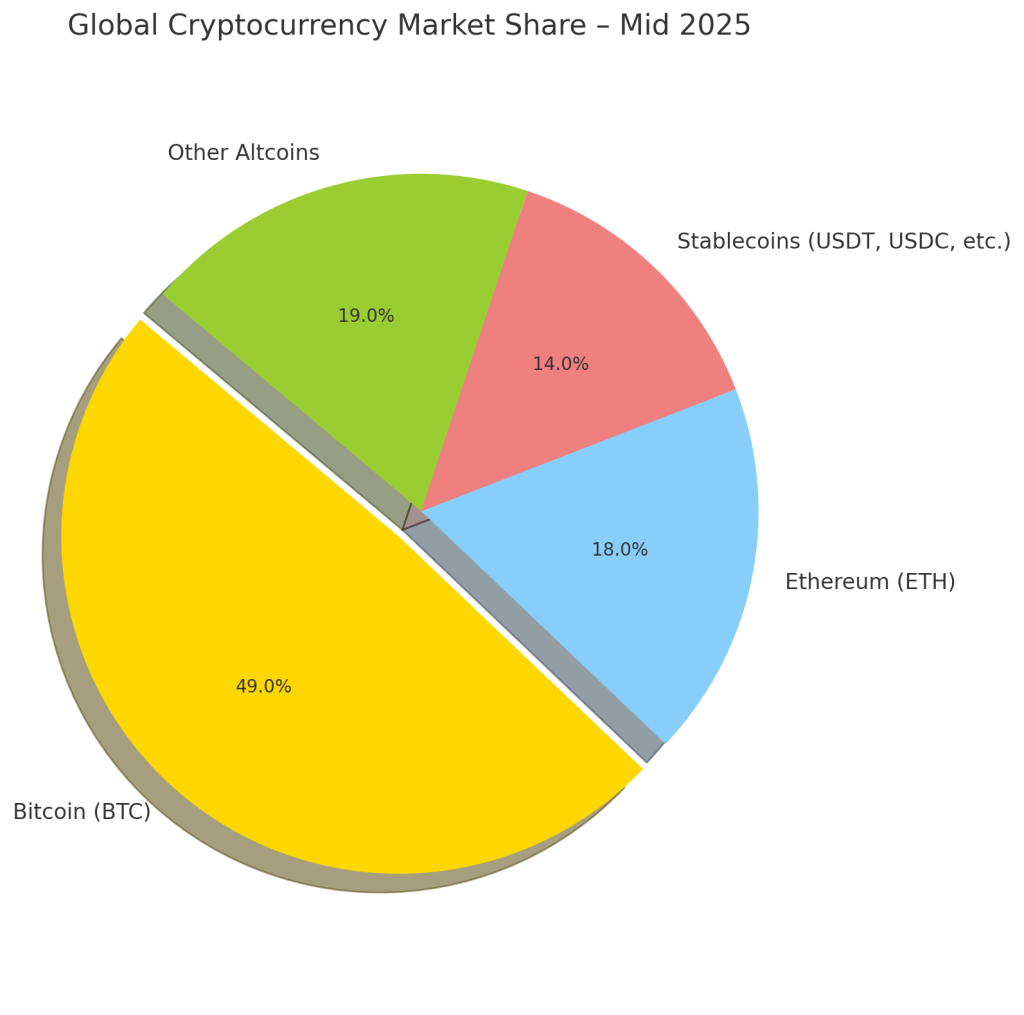
Here is a pie chart showing the global cryptocurrency market share as of mid-2025.
7. Tokenomics: Scarcity vs. Burn Mechanism
Bitcoin has a fixed supply of 21 million coins, a fact often touted as one of its biggest advantages. This hard cap makes BTC deflationary by design, appealing to those who want an asset immune to central bank manipulation.
Ethereum doesn’t have a fixed cap—but its post-London hard fork (EIP-1559) introduced a base fee burn mechanism that can make ETH deflationary under certain conditions. In fact, during periods of high network usage, more ETH is burned than issued—shrinking total supply.
This “ultrasound money” narrative has become a major Ethereum talking point. It offers a flexible, adaptive alternative to Bitcoin’s fixed issuance—one that aligns ETH supply with actual network activity.
8. Risk Factors: What Could Prevent a Flippening?
While Ethereum’s trajectory is promising, several risks could prevent it from overtaking Bitcoin by 2030:
- Complexity: Ethereum’s programmability makes it vulnerable to bugs, exploits, and smart contract failures. The more functionality it offers, the more potential attack surfaces.
- Scaling struggles: While rollups and layer 2s offer relief, Ethereum still struggles with base-layer scalability. Competing blockchains offer faster and cheaper alternatives—though often at the expense of decentralization.
- Regulatory risk: Because Ethereum supports a wider range of financial activities, it’s more exposed to regulatory scrutiny, especially in DeFi and token issuance.
- Fragmentation: The Ethereum ecosystem is massive—but sometimes chaotic. Competing layer 2s, forks, and governance disputes can weaken cohesion.
Bitcoin, by contrast, benefits from its simplicity and narrow use case. Fewer moving parts mean fewer things can go wrong.
9. Public and Political Perception
Bitcoin is increasingly being seen as an apolitical, decentralized alternative to fiat currencies—especially in regions with inflationary crises or authoritarian regimes. It has gained support from libertarians, financial conservatives, and even some politicians in the U.S. and Latin America.
Ethereum, while powerful, is more complex to understand and explain. Its evolving monetary policy, experimental governance ideas, and association with speculative DeFi or NFT projects may limit its broad appeal.
However, Ethereum’s push toward ESG compliance, staking rewards, and real-world use cases (like tokenized bonds and supply chains) may help it gain ground with institutional and government partners.
10. Will It Actually Happen by 2030?
Let’s break down possible future scenarios:
- Scenario 1: The Flippening Happens by 2027–2030
Ethereum scales successfully, dApps go mainstream, DeFi becomes regulated and embraced, and ETH surpasses BTC in market cap. BTC remains strong, but ETC becomes crypto’s main economic layer. - Scenario 2: Bitcoin Remains Dominant
Institutional adoption deepens, Bitcoin becomes a digital reserve asset or treasury standard, and its simplicity proves to be a feature, not a bug. Ethereum grows but stays second. - Scenario 3: A Third Contender Rises
An unexpected platform (perhaps Solana, Avalanche, or a new chain) offers massive scalability and adoption, pulling users and developers from both ETH and BTC. The Flippening becomes less relevant.
The most likely outcome? A kind of “dual dominance,” where Bitcoin serves as the digital equivalent of gold—while Ethereum powers the decentralized digital economy.
Conclusion: Ethereum’s Rise is Real, But Bitcoin’s Reign Isn’t Over Yet
So, will Ethereum overtake Bitcoin by 2030?
It’s possible. Ethereum has the innovation, developer energy, and ecosystem growth to make a serious run for the throne. Its transition to proof-of-stake, deflationary burn model, and broad utility put it at the center of crypto’s most promising trends.
But Bitcoin’s first-mover advantage, brand recognition, simplicity, and growing institutional embrace still make it the heavyweight champion.
In the end, both networks may thrive in parallel, serving different roles in the financial future. Ethereum doesn’t have to kill Bitcoin to succeed—just like email didn’t replace the telephone. They’re different tools for different jobs.
If you’re an investor, developer, or crypto enthusiast, the key is not to bet blindly on one horse—but to understand the strengths, weaknesses, and evolution of both.
The flippening might happen—or it might not. But watching it unfold will be one of the most fascinating stories in finance over the next five years.
Looking Beyond the Numbers: Philosophical and Economic Divergence
One important distinction between Bitcoin and Ethereum is philosophical. Bitcoin’s mission is singular: to be a censorship-resistant, decentralized store of value. Its community is guided by principles of minimalism, scarcity, and uncompromising decentralization. Bitcoin is intentionally slow to change—it’s more akin to a digital Constitution than a software product.
Ethereum, on the other hand, is dynamic and adaptive. It aspires to be the “world computer,” powering everything from decentralized finance and gaming to identity systems and prediction markets. Its roadmap is fluid, embracing change in pursuit of better scalability and functionality. This creates both opportunity and complexity.
From an economic perspective, Bitcoin’s capped supply makes it attractive, although not bulletproof to crash, in inflationary times, but Ethereum’s adaptive monetary policy—with burn mechanisms and staking incentives—offers a more responsive economic engine.
As investors begin to view crypto through a more nuanced lens, they may realize that Bitcoin and Ethereum are not in a zero-sum game. They serve different purposes in a multi-chain future.
If 2021–2025 was about adoption and survival, then 2025–2030 may be about maturity and utility. And in that era, Ethereum’s flexibility might give it the edge—at least in terms of economic activity, developer mindshare, and market influence.
Will it be enough to surpass Bitcoin in market cap? Time—and the next bull or bear cycle—will tell.